
SKILLS TO BE RECOGNISED
- Skills can be recognised as credentials, represented by a digital badge or personal evidence record when the skill criteria has been met by a learner.
- LEARNING OUTCOME
Understand what skills and skill elements you want to recognise and descibe them with clarity.
Why
- You need to know what skills and skill elements you want to digitally recognise.
- Ask yourself – why do you want to recognise these skills? e.g. To assist learners with gaining employment during or upon graduation.
- Understanding your reasons for skills recognition may aid in the selection of skills you wish to recognise.
What it is
- Skills identify abilities and capabilities – what we know and can do. Both hard and soft skills can be recognised in digital credentials:
- Hard skills are specific abilities, capabilities and skill sets that enable individuals to perform job-specific tasks, or that may be required for a specific job. They are also known as ‘technical skills’, ‘academic skills’ and ‘competency skills’.
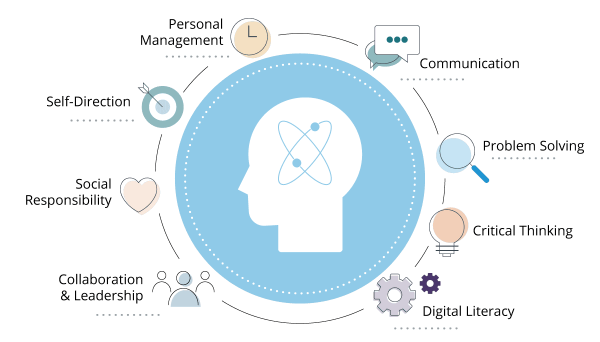
- Durable skills are a competency or capability that is foundational and enduring, enabling individuals to effectively engage with and navigate various learning experiences and environments over time. These skills often include critical thinking, problem-solving, information literacy, adaptability, and self-regulated learning. They are also known as ’21st-century skills’, ‘soft skills’ and ‘transferrable skills’.
- A skill has a defined criteria and skill statements articulating observable and measurable behaviors.
- For a skill to be recognised via a digital credential, it needs to be embedded in assessed learning.
What you need
- A skill or list of skills you wish to recognise and award via a digital credential and a definition / description of the skill(s).
- For each skill, a list of elements and descriptions.
Where to get it
- Your institution may have already identified skills they wish to recognise.
- You can identify and draft your own.¹ Search openRSD for ideas of skills to recognise.²
- Existing course rubrics and learning outcome statements can be useful inputs when designing the elements and their descriptions.
- See the AI Pro Tip section below for ways you can use AI to help you complete this step.
- PUTTING IT INTO ACTION
- Download this worksheet template (MS Excel format) – we will continue to build this out through the rest of the guide.
- At the top of the sheet, specify the skill being recognised and write a description – a skill definition.
- In column one, identify the skill elements – the attributes of the skill.
- In column two, draft a description for each element – the skill statements articulating observeable and measureable behaviour(s).
AI Pro Tip
Ensuring you remain in compliance with your institution’s AI Policies, open a deep research tool, such as NotebookLM, Microsoft 365 Copilot Notebooks, Anara or similar.
- Input the course content, assessments and learning outcomes.
- Ask the AI to help you extract the skills that could be recognised from the course material, cross referenced with where in the curriculum that skill is taught, and what assessment is used to measure it (see examples below).
PROMPT EXAMPLES
Prompt (for Structured Data Extraction)
This prompt asks the AI to act as an analyst and deliver the required data in a clean, parsable table format, which is ideal for transferring the information into a skills matrix or spreadsheet:
“Analyse the following course content, learning outcomes, and assessment rubrics. Your task is to identify and extract all observable, measurable skills that a learner is taught and assessed on. Present the findings in a markdown table with three columns: ‘Skill Identified’, ‘Curriculum Location (e.g., Module/Week)’, and ‘Assessment Method Used’.”
[Paste Course Content, Learning Outcomes, and Assessment Details Here]
Prompt (for Element and Description Focus)
Use this prompt to extract the detailed skill elements and skill statements (observable behaviors) that define a larger skill, rather than just the high-level skill name:
“Act as a skills recognition specialist. Review the provided curriculum documents and identify specific Skill Elements and the observable, measurable Skill Statements that underpin them. For each skill statement identified, cross-reference it with the corresponding curriculum activity where it is developed and the specific assessment criteria used to evaluate mastery. Format the output as a clear, hierarchical list.”
[Paste Course Content, Learning Outcomes, and Assessment Details Here]
Key Prompting Strategies
- Define the role – start by assigning the AI a persona (e.g., “curriculum analyst,” “skills recognition specialist”) to prime its linguistic style and focus.
- Specify the output format – explicitly requesting a markdown table or hierarchical list prevents the AI from giving a verbose, free-form answer that would be hard to process.
- Use specific terminology – using terms like “observable,” “measurable,” and “cross-reference” ensures the AI extracts skills that meet the criteria for digital recognition (i.e., they must be proven by evidence).
¹ See examples of durable skills and their attributes from Education Design Lab’s Durable Skills Microcredentials. Simply click on any of the durable skills and you’ll see the elements and their descriptions.
² openRSD is the world’s largest open access library of rich skill descriptors (RSD), contributed by the open skills community (e.g. non-profit organisations, education institutions and organisations), that you can reference in digital documents (e.g. resumes, job descriptions and digital badges), to provide a standardised definition of a skill.