
SKILLS ALIGNMENTS
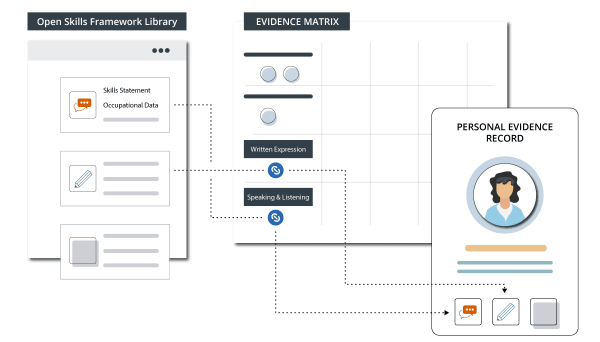
- Skill alignments can be created for each element in an Evidence Matrix. The skill name and its URL link can be presented on an evidence record.

- LEARNING OUTCOME
Understand the importance of using standardised skill descriptions that are machine actionable.
Why
- Using standardised skill descriptions enable a common language that can be clearly read and understood by everyone.
- They are are human and machine readable, and machine actionable. This enables skills data mobility and portability.
- When implementors use skills in common ways, it creates an ecosystem where achievements, pathways, and learner records can make machine-readable references to skills, and allow systems to take action based on the skills learners hold.
- Using a standard schema aids quality and ensures completeness of data, which is converted into metadata.
What it is
- A skill definition that accompanies an element in an Evidence Matrix and can appear on an evidence record.
- It has a URL that the learner, employer or viewer can click to see further standardised details about the skill.
- A skill statement provides supporting information for an element in an Evidence Matrix and can align that element to relevant skill, scholarly and occupational information.
What you need
- An understanding of each element of the Evidence Matrix data and how it may be supported by additional skills information.
- A publicly accessible skills framework to align to the elements.
Where to get it
- Public or private skills libraries, for example:
- See the AI Pro Tip section below for ways you can use AI to help you complete this step.
- PUTTING IT INTO ACTION
- Open the worksheet used in the previous step.
- In the column ‘Skills alignment(s)’, input the URL of the skill definition or rich skill descriptor (RSD).¹
AI PRO TIP
Ensuring you remain in compliance with your institution’s AI Policies, open an AI tool such as NotebookLM, Microsoft 365 Copilot Notebooks, Anara, ChatGPT, Gemini or similar.
Search the standard – manually search a standardised skill library like openRSD for terms related to your local skill element (e.g., search for “teamwork” or “self-awareness”).
Input local and standard data – input the complete list of your local Skill Element Descriptions along with the relevant names, descriptions, and unique URIs of the standardised RSDs found in your search.
Ask for precision mapping – use the appropriate prompt (like Prompt 1) to instruct the AI to perform a precise one-to-one match between your local descriptions and the standardised RSDs.
Confirm the URI – critically verify that the AI’s output includes the correct RSD Unique Identifier (URI) for the chosen match, as this is the key to making your skill data universally understandable.
Finalize alignment – insert the confirmed RSD URI into your final skill record to ensure the skill is defined using an authoritative, standardized source.
prompt examples
The goal is to align your highly granular local skill elements (the observable, measurable behaviors) to the corresponding standardised RSD:
Prompt 1 (Precise RSD Matching)
This prompt asks the AI to act as a data validation expert, making the most accurate match between the local element and the external standard:
“Act as a Rich Skill Descriptor (RSD) mapping specialist. I have identified a local skill element description and a set of candidate RSDs. Your task is to perform a precise, semantic alignment between the local description and the RSDs provided. Present the findings in a three-column markdown table showing the ‘Local Skill Element Description’, the ‘Matching RSD Name’, and the ‘RSD Unique Identifier (URI)’.”
Local Skill Element Description: [Paste the Skill Statement, e.g., ‘Identifies opportunities for change and seeks support in execution’]
Candidate RSDs: [Paste the names, descriptions, and URIs of 3-5 relevant RSDs you found on openRSD]
Prompt 2 (Quality Check and Rewording)
Use this prompt to ensure your local element definition is as clear and standardised as possible before final alignment:
“Review the following local skill element description against the best-matched Rich Skill Descriptor (RSD) definition provided below. Identify any semantic gaps or ambiguities in the local description. Suggest a revised local skill element description that maintains the original intent but uses language more closely aligned with standardised terminology and the RSD’s definition.”
Local Skill Element Description: [Paste local description]
Best Match RSD Definition & URI: [Paste the full text of the RSD definition and its URI]
Key Prompting Strategies
- Focus on the URI – the primary output must include the RSD’s Unique Identifier (URI). Without this standardised link, the alignment is just text and cannot be used for data portability.
- Emphasise semantic alignment – the AI must look beyond keywords. Instruct it to find alignment based on meaning and intent (e.g., comparing “Identifies mistakes” to “Acknowledges failure”).
- Match granularity – ensure the AI is aligning the smallest possible local unit (the Skill Element/Skill Statement) to the smallest possible external unit (the RSD).
¹ Rich skill descriptors (RSDs) are human and machine-readable skill definitions that can be referenced from digital credentials, learner records, pathways, and job profiles. RSDs are published by skill authors, and conform to a standard global schema. They contain rich metadata and alignment and provide a universal skills vocabulary.