
FRAMEWORK ALIGNMENTS
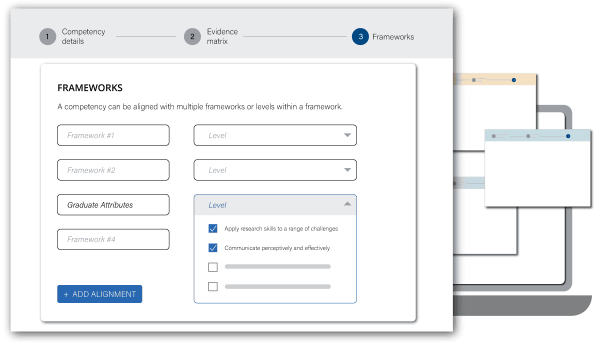
- Frameworks benchmark and validate the skill against recognised and defined standards. Framework alignments may be presented on an evidence record, providing meaningful context to the consumer of the credential (employers).
- LEARNING OUTCOME
Understanding of the educational and other frameworks that your skills align to. Understand the importance of connecting skills to external standards and benchmarks.
Why
- Mapping your skills to Frameworks can add weight and validation by benchmarking the capabilities described for the skill against defined standards.
- It helps the learner, employer and others to contextualise the learner’s skills in real-world settings. They can make direct, apples-to-apples comparisons, providing greater relevancy and meaning.
What it is
- A Framework is a tool that provides a structured approach, set of guidelines, or conceptual model to help individuals or organisations accomplish specific objectives.
- A Framework can be anything that aligns to the curriculum and/or to the skill and gives it a grounding in context. It may be in any format and ideally has a website URL for reference.
- Frameworks are aligned to the overarching skill, not the skill elements.
- You can align skills to multiple Frameworks and/or Framework levels.
What you need
- A publicly accessible Framework that aligns with the skill and scholarly or industry capabilities.
- Knowledge of how particular aspects or levels of the Framework can be mapped to the skill being assessed.
Where to get it
- Examples of publicly accessible frameworks include:
- PUTTING IT INTO ACTION
- Open the worksheet used in the previous step.
- Under the heading ‘Framework Alignment(s) and Levels’, input the URL of the publicly available Framework, including applicable levels. More than one Framework or level can be referenced for a skill and can be hyperlinked from an evidence record.
AI PRO TIP
Ensuring you remain in compliance with your institution’s AI Policies, open an AI tool such as NotebookLM, Microsoft 365 Copilot Notebooks, Anara, ChatGPT, Gemini or similar.
- Input the local data – input the complete description of the skill, including its Name, Definition, and all Behavioral Descriptions (the five levels from your Evidence Matrix).
- Input the framework data – provide the AI with the list of potential external frameworks (or the content of a specific framework’s taxonomy, if known).
- Ask for conceptual alignment – ask the AI to use the appropriate prompt (like Prompt 1) to identify which external framework is the best conceptual and structural match for your local skill.
- Ask for detailed mapping – if a framework is chosen, input that framework’s data and ask the AI to perform a detailed, descriptor-by-descriptor mapping to identify the exact, corresponding skill codes (as per Prompt 2).
- Validate the output – review the AI’s suggested alignments, paying close attention to its confidence scores and rationale, to ensure the external skill description accurately reflects your institution’s assessed learning outcome.
prompt examples
The goal here is to ask the AI to act as a Skills Mapping Analyst and compare your internal skill definitions and descriptions (from the Evidence Matrix) against the available external frameworks:
Prompt 1 (Best Framework Identification)
Use this prompt to determine which external framework is the best conceptual fit for your local skill:
“Act as a global skills mapping analyst. I have defined a skill, its elements, and the five performance descriptions used to assess it. Your task is to identify the single most relevant external skills framework for this skill from the following list: [Australian Skills Classification, SFIA, ESCO, O*NET, Durable Skills Advantage Framework, UNESCO AI Competency Framework, etc.].
Provide your rationale for the chosen framework, focusing on alignment in terminology, granularity, and purpose (e.g., job-centric vs. durable skills).
Local Skill Name: [Insert Skill Name, e.g., ‘Act as a Catalyst’]
Performance Descriptions: [Paste all five performance descriptions from your Evidence Matrix here, e.g., ‘Emerging: Shows budding interest in sparking change but seeks guidance. … Advanced: Serves as a powerful catalyst for change.’]”
Prompt 2 (Detailed Alignment Mapping)
Use this prompt once you have selected an appropriate framework (e.g., ESCO) and need the AI to perform the detailed, descriptor-by-descriptor mapping:
“Using the provided external skills framework data, identify the most precise one-to-one match for the local skill described below.
Create a three-column markdown table that maps each of my local skill’s behavioral descriptions to the corresponding standard skill/competency code and descriptor from the chosen framework, and include a confidence score (High, Medium, Low) for the match.
External Framework Data: [Paste relevant section of the external framework’s documentation/taxonomy here]
Local Skill Details: [Paste Local Skill Name, Definition, and all Evidence Matrix descriptions here]”
Key Prompting Strategies
- Specify the target corpus – always provide the AI with a list of the specific external frameworks to consider, or, even better, paste the relevant excerpts of the framework data you want it to match against.
- Insist on granularity – the AI must align the local skill descriptions (the behavioral statements) and not just the skill name. An alignment at the descriptor level is always stronger than an alignment at the top-level name.
- Demand rationale and confidence – asking for a rationale or a confidence score prevents the AI from simply guessing and forces it to articulate why it chose a match, making its output much more useful for quality assurance.