RESOURCES

In this section:

Templates & Examples

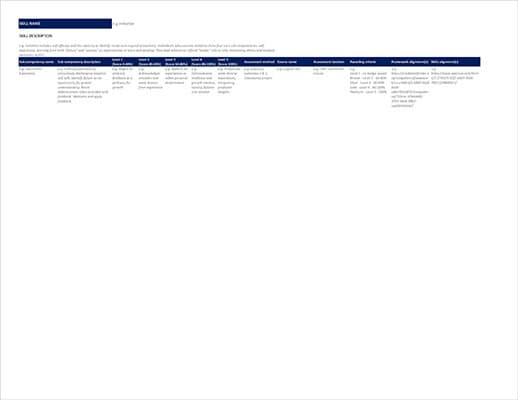
Below are a variety of templates, examples and links to resourses that may be of assistance as you complete this guide:

Note – download images via the share icon Share Icon 

If you’re just starting out on your skills journey, you can find useful information here:

For more general skills terminology, we refer you to the following lists:

Learn more about rich skill descriptors (RSDs):

Learn more about Credentialate:

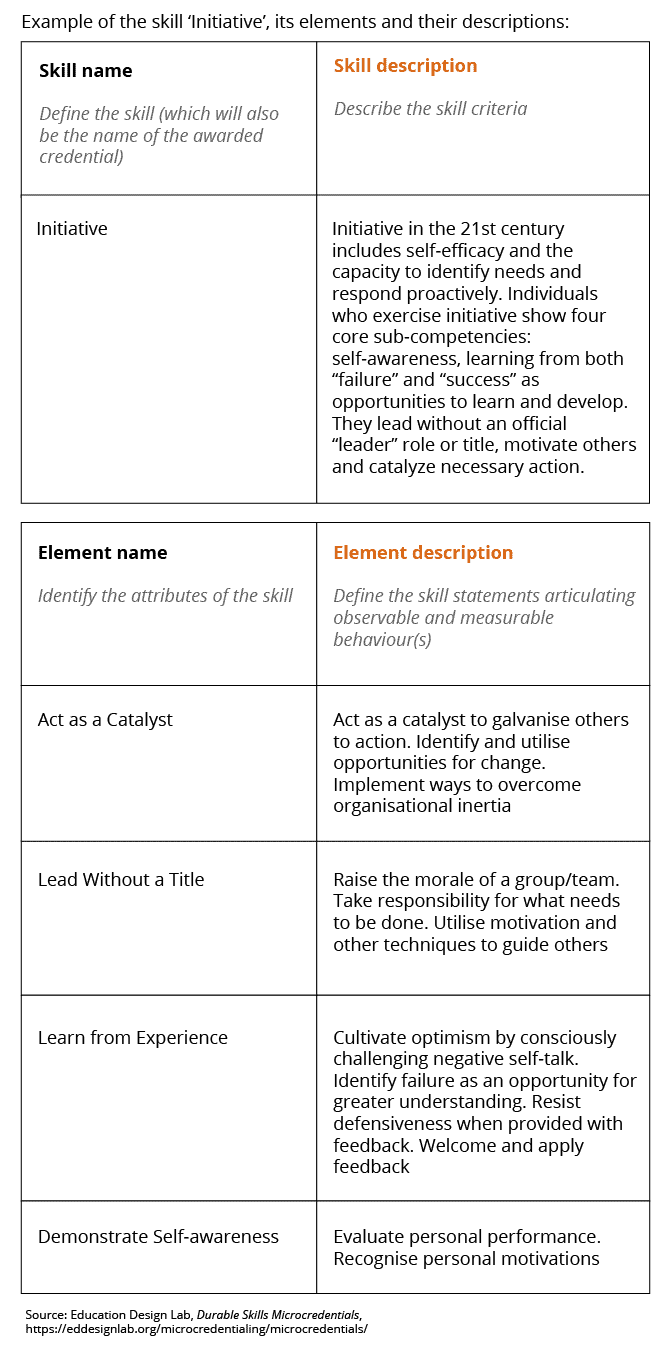
Education Design Lab’s Durable Skills Microcredentials

An example of durable skills with sub-competencies and descriptions

openRSD

The world’s largest open access library of rich skill descriptors (RSDs)

Personal Evidence Records

Possible output of education technologies, displaying skills and sub-competencies

Australian Skills Classification

An example of a national skills classification system

Australian Curriculum General Capabilities

An example of a national framework for durable skills in K-12

Skills for the Information Age (SFIA)

The global skills and competency framework for the digital world

European Skills, Competences, Qualifications and Occupations (ESCO)

The European multilingual classification of skills, competences and occupations

Durable Skills Advantage Framework (America Succeeds)

An employer-generated common lexicon for essential non-technical skills

Pathsmith (Commercial durable skills framework)

O*NET OnLine

Hundreds of standardized and occupation-specific descriptors on almost 1,000 occupations covering the entire U.S. economy

National Foundation Skills Framework 2022 to 2032

An example of a vocational education and training (VET) framework

Engineering Skills Framework

An example of an industry specific skills and competency framework

Credential Engine

A non-profit mapping the credential landscape with consistent information and resources that empower individuals to find the best pathways

UNESCO AI Competency Framework

For teachers – defines the knowledge, skills and attitudes that teachers should possess to understand the roles of AI

For students – will articulate the knowledge, skills and attitudes students should acquire to understand and actively engage with AI 

What Are Rich Skill Descriptors (RSDs)?

Answers the question – what  are rich skill descriptors (RSDs)?

What Benefit do RSDs Provide?

Outlines the benefits that rich skill descriptors provide to multiple stakeholders

How do RSDs Fit in the Skills Ecosystem?

An explanation of where RSDs fit in the skills ecosystem and how they enable data granularity, mobility and portability

How to Search for RSDs in openRSD

A step-by-step guide for how to search for RSDs on the openRSD platform

Lightcast Skills

Lightcast is the pioneer and market leader in global labor analytics

WGU Skills Library

An open resource of structured skills data leveraged to promote a more equitable skills-driven hiring and education ecosystem

Review checklist

Expand on the items below to check you have completed each step:

  • Create a list of the skills you wish to recognise.
  • Create a list of the elements (abilities and capabilities) you want to recognise via a digital credential.
  • List all of the elements (from the attributes list) that make up the skill. Review the list to ensure each element provides a clear context and understanding of what the skill entails. These elements should contribute to overall competence in the skill.
  • Ensure each element has a description – skill statements that articulate the observable / measurable behaviour to be demonstrated by the student.
  • Identify where and how in the curriculum the elements are taught and assessed. 
  • Ideally these assessments exist in your data source (LMS or equivalent) so they can be connected to score data from them.
  • Map elements to assessments and determine awarding levels.
  • Decide the awarding model you would like to implement for your skill. Does your institution have a mastery program with levels of mastery that can be applied to this model?
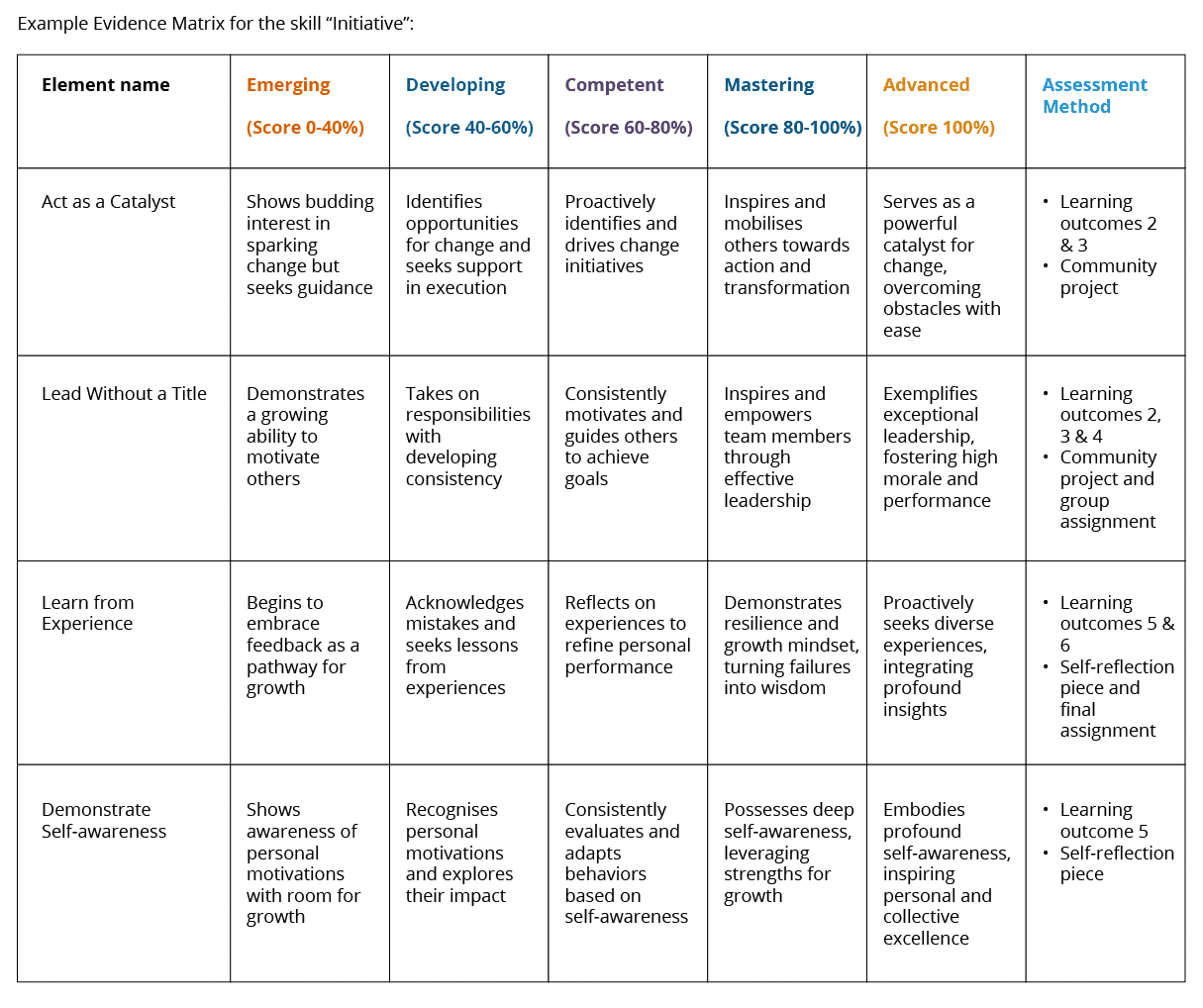
  • Create an Evidence Matrix rubric that includes the elements, their descriptions, the awarding criteria and the assessment methods.
  • Note that the more granular the awarding criteria, the more element descriptions, which reflect the awarding criteria levels, will be required.
  • You will need to complete the above steps for each Credential you wish to award against. 
  • Align (map) your skills to publicly available Framework data to provide meaning and context.
  • Align (map) skill elements to standardised skill definitions to provide clarification and labour market data.

Edalex offer a range of professional services to help your organisation make the shift to skills – from initial consultation to in-house training to full implementation services. We can get you started and provision you and your teams with the ability to act fast.

All of our strategic consulting services can be conducted as platform agnostic (independent of our platforms), or in coordination with our skills-based platforms (Credentialate and openRSD).

Scroll to Top