

Key takeaways
- Unlocking latent abilities – just as tools amplify physical capabilities, technology acts as a powerful catalyst, providing access to knowledge, resources, and innovative methods that significantly enhance human potential and productivity across various domains.
- Cultivating relevant expertise – to thrive in the evolving landscape of work, education must shift towards skills-based learning. This approach equips individuals with practical abilities and real-world competencies, ensuring they are well-prepared to meet the demands of the modern workforce.
- Showcasing holistic achievement – Learner Evidence Records (LERs) represent a transformative approach to documenting and presenting an individual’s comprehensive skills, experiences, and achievements. By offering a rich, verifiable portrait of a learner’s capabilities, LERs effectively bridge the divide between education and employment.
Technology is an essential part of education, helping people reach their full potential. Skills-based learning prepares students for jobs by teaching them practical skills instead of just memorising information or showing a completed course on a transcript.
But how do we move from an institutional and course-based learning system to one that is leaner-centric and based on the skills they obtain from a course rather than the grade they receive?
At Edalex, we believe the answer lies in using technology as the tool to unlock human potential and help learners showcase what they know and can do to employers through a more robust format than a simple resume.
Because human potential is unlimited, we want to encourage educators and organisations to adopt new methods that support workforce development and flexibility by highlighting technology’s transformative power.
The Role of Technology in Unlocking Human Potential
Technology plays a crucial role in personal and professional development. It empowers individuals by providing access to resources, knowledge, and tools that enhance their capabilities. With the right digital tools, people can unlock their potential and achieve remarkable growth.
Key functions of technology:
-
- Enhancement of individual capabilities – digital solutions allow individuals to expand their skill sets and improve their performance across various fields. For instance, online learning platforms offer courses on demand, enabling learners to acquire new skills at their own pace and showcase those skills through digital credentials and information added to their Learner Evidence Record (LER).
-
- Boosting productivity – digital tools streamline workflows and automate repetitive tasks. This saves time and allows individuals to focus on more strategic aspects of their work. Knowledge of these platforms puts learners ahead of their competition in the workplace and can also help streamline the education process.
In short, technology’s key function is to enhance human capabilities and potential. This also applies to the transition to skills-based learning.
Transitioning to Skills-Based Learning
Skills-based learning represents a transformative approach in modern education. It focuses on equipping learners with practical abilities necessary for today’s dynamic workplace. This method prioritises the acquisition of specific competencies over traditional rote memorisation or theoretical knowledge alone. By emphasising real-world applications, skills-based learning prepares individuals for immediate employment while fostering adaptability in an ever-evolving job market.
The Shift from Traditional Education Models
Traditional educational models often emphasise a one-size-fits-all curriculum, where examinations and grades primarily measure success. While this approach has its merits, it frequently fails to address the unique needs of different learners or the demands of contemporary industries.
In contrast, skills-based learning encourages:
-
- Personalised learning paths – tailoring education to fit individual strengths and interests.
-
- Practical applications – engaging learners in hands-on experiences directly correlating with their future careers.
-
- Collaborative learning – promoting teamwork and communication skills essential in most workplaces.
By focusing on these elements, educators can foster an environment that enhances workforce readiness, allowing learners to graduate with theoretical knowledge and valuable practical experience, in other words, unlocking and showcasing human potential using technology.
Importance of Practical Skills for Workforce Readiness
The modern workforce requires individuals who can think critically, solve problems creatively, and apply their skills effectively. Skills-based learning helps bridge the gap between education and employment by emphasising the following:
-
- Targeted skill acquisition – teaching specific competencies employers require, such as coding, project management, or digital marketing.
-
- Hands-on experience – providing opportunities for internships, apprenticeships, and project-based assignments that reinforce learning through practice.
Research indicates that people who engage in hands-on experiences are more likely to retain information long-term, and educators can better evaluate skills.
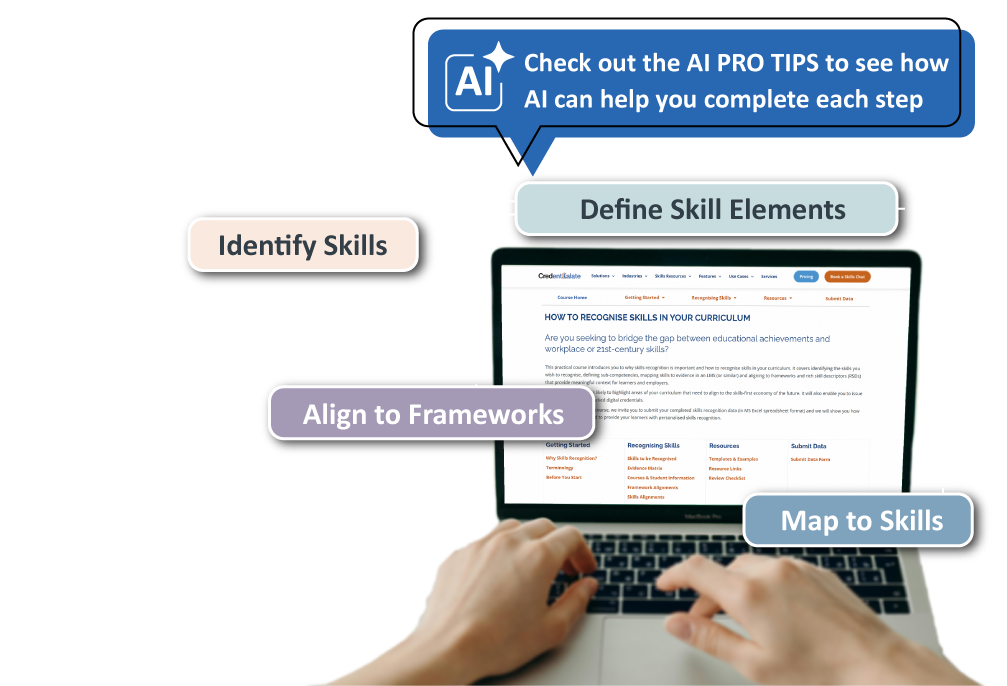
Free Self-Paced Guide
HOW TO RECOGNISE SKILLS IN YOUR CURRICULUM
Access step-by-step instructions, explanations and templates. Submit your work to see how you can recognise skills in your curriculum
Benefits and Challenges of Implementing Skills-Based Learning
We often speak of the benefits of skills-based learning. Here are a few of the key ones:
-
- Increased employability – graduates emerge with competencies that align closely with industry needs, making them more attractive to employers.
-
- Enhanced retention – practical application reinforces learning concepts, leading to better retention rates and in the long run, better retention of employees.
-
- Lifelong learning mindset – learners develop a habit of continuous improvement and adaptability, which is crucial in a rapidly changing work environment where they are unlikely to stay in a single career, let alone a job, throughout their lifetime.
Yet, at the same time, there are challenges we cannot ignore. Here are some of the obstacles we and learning institutions face. Because despite its advantages, the transition to skills-based learning is fraught with obstacles:
-
- Curriculum adaptation – many traditional institutions struggle to update their curricula to reflect current industry standards and technological advancements. This lag creates a disconnect between what students learn and what employers require.
-
- Resistance to change – educators accustomed to conventional teaching methods may struggle to embrace new approaches that demand active participation and collaboration.
-
- Resource allocation – implementing effective skills-based programs often requires investment in training facilities, technologies, and instructor professional development.
Moving Forward
As we explore this evolving educational landscape, it becomes clear that integrating technology into skills-based learning is vital. Technology facilitates personalised learning experiences and supports the development of essential digital skills needed in modern workplaces.
By embracing this innovative approach to education, we can unlock human potential on a broader scale – transforming how individuals learn and equipping them for career success. The journey towards a more adaptable workforce hinges on our willingness to adapt educational practices to meet contemporary demands.
Digital Learner Evidence Records (LERs) as a Tool for Skill Communication
Learner Evidence Records (LERs) are comprehensive digital portfolios that capture an individual’s educational journey, skills, and achievements. These records document formal qualifications and highlight informal learning experiences, certifications, and competencies gained through various activities. The main goal of LERs is to establish a clear communication channel between learners and employers, helping assess a candidate’s fit for specific roles.
Employers often struggle to accurately assess a candidate’s abilities based solely on traditional resumes. Here’s where LERs come into play:
-
- Holistic overview – LERs provide a richer picture of an individual’s skills, showcasing real-time evidence of competencies.
-
- Dynamic updates – as learners acquire new skills or complete projects, they can update their LERs instantly, ensuring employers receive the most current information.
-
- Skill verification – LERs enhance credibility by validating the learner’s claims through endorsements from educators or industry professionals.
By facilitating this level of transparency and communication, LERs bridge the gap between what learners possess in terms of skills and what employers seek in potential hires. Verification is simple, and if skills have been self-reported by the learner, the LER also makes that evident.
Ideally, this is like a resume that has already been verified or can be validated at the touch of a button. For HR departments, this means no more multiple phone calls, sending for digital education transcripts, and more. All that information is at their fingertips.
For learners, this means proof of their skills follows them wherever they go and is based on evidence, not the whim of a former employer, a vague transcript, or a misstated job description.
Features, Benefits, and Integration with AI Technologies in LERs
While Artificial Intelligence (AI) technologies are new and emerging, such as SkillsAware, they can be used to elevate LERs to new heights. There are some applications already being applied in various forms:
-
- Personalised learning paths – learners can customise their pathways according to their career aspirations and interests, which increases engagement and motivation.
-
- Competency tracking – built-in mechanisms for tracking progress over time allow learners to visualise their growth in various skill areas. This feature is crucial for identifying strengths and areas needing improvement.
Advantages start at the course and education level and are enhanced from there as learners transition to being earners. But the benefits of AI in LERs extend beyond mere documentation:
-
- Enhanced employability – by presenting a well-rounded skill set backed by evidence, learners significantly boost their chances of impressing potential employers.
-
- Real-time feedback – AI-driven tools can analyse learner data to offer constructive feedback tailored to individual needs and even let learners know what kind of courses or certifications might best benefit their long-term career goals.
Customisation Options Within LERs
Customisation is key to making LERs truly effective. Each learner’s journey is unique; thus, having options allows them to highlight relevant experiences. Customisation features may include:
-
- Skill categories – learners can organise competencies into categories that align with specific job requirements or industries.
-
- Visual elements – the ability to incorporate videos or images provides a more engaging view of accomplishments and projects.
Such personalised approaches ensure that each learner’s evidence record reflects their distinct path while remaining relevant to prospective employers.
As AI advances and becomes more integrated into various systems, the development also impacts the functionality of LERs:
-
- Skill assessment algorithms – advanced algorithms can analyse data within the records to accurately evaluate a learner’s proficiency levels. This capability allows for objective comparisons against industry standards.
-
- Automated validation processes – learners’ skills can be verified automatically through integrated assessments or simulations, providing instant feedback on performance.
Incorporating AI into LERs streamlines processes and fosters trust among stakeholders involved in hiring decisions. While not fully implemented by educators and companies yet, the increased use of AI ensures that LERs are the resume replacement of tomorrow, and tomorrow is closer than we think.
Embracing tools like Learner Evidence Records will become essential in shaping a future-ready workforce equipped with the necessary skills for success.
Technology and Unlocking Human Potential
Embracing technology’s impact on education is essential for preparing the future workforce. Educators and organisations play a crucial role in this transformation. Integrating technology-driven education reform can enhance learning experiences and ensure learners acquire the skills necessary to thrive in a rapidly changing job market.
Key actions include:
-
- Adopting innovative teaching methods – leveraging digital tools to create interactive and engaging learning environments.
-
- Fostering collaboration – encouraging partnerships between educational institutions and industries to align curricula with real-world needs.
-
- Prioritising upskilling initiatives – creating pathways for continuous development that empower individuals to adapt to technological advancements.
Using technology to unlock human potential means investing in our collective future. It requires commitment from all stakeholders to participate actively in this educational evolution, ensuring that learners are not just prepared but inspired to succeed in their careers.
FAQs
- How does technology truly “unlock” human potential?
Technology acts as a powerful enabler, providing broader access to information, learning resources, and tools that can significantly enhance individual skills, productivity, and creativity. It removes geographical barriers and offers personalised learning experiences, ultimately allowing individuals to reach their full potential. - What is “skills-based learning,” and why is it important?
Skills-based learning is an educational approach that focuses on developing specific, demonstrable abilities and competencies relevant to real-world applications and the demands of the modern workforce. It’s highlighted as crucial because it directly addresses the evolving needs of employers and equips learners with practical expertise. - What are Learner Evidence Records (LERs), and how do they differ from traditional academic transcripts?
Learner Evidence Records (LERs) are digital portfolios that provide a comprehensive and verifiable record of an individual’s skills, experiences, achievements, and credentials. Unlike traditional academic transcripts, which primarily focus on course completion and grades, LERs can include a wider range of evidence, such as projects, competencies, and micro-credentials, offering a more holistic view of a learner’s capabilities. - How can the adoption of technologies like AI contribute to unlocking human potential in education and the workforce?
Technologies like AI can analyse vast amounts of data to personalise learning pathways, identify skill gaps, and match individuals with relevant opportunities. In education, AI can provide tailored feedback and support. In the workforce, it can help individuals identify career paths aligned with their skills and assist employers in finding the right talent. - What are some of the key benefits for individuals and organisations in embracing the approaches discussed (technology, skills-based learning, LERs)?
For individuals, these approaches can lead to more relevant education, better career prospects, and enhanced recognition of their diverse skills. For organisations, they can result in a more skilled and adaptable workforce, improved talent acquisition, and a better alignment between employee skills and business needs.