
Key takeaways:
- Learner-centric approach – just like designing homes for comfort and personal preferences, education systems must prioritise learners’ needs. This means making skills visible and relevant through robust systems like Credentialate and openRSD, ensuring each learner’s journey is transparent and tailored.
- Limitations of traditional tools – traditional learning management systems (LMS) and badge agents have limitations in managing detailed skills data effectively. They often require additional tools to fill the gaps, highlighting the need for more integrated and efficient solutions.
- Role of technology – technology, particularly AI, plays a crucial role in improving educational efficiency by analysing curriculum data to extract and align skills with industry standards. This ensures that educational offerings remain relevant and aligned with workforce needs.
- Transparency and verification – The need for transparent, verifiable digital credentials is essential. This transparency builds trust between learners and employers, making the transition from learning to employment smoother.
When a home is designed and built, there are some central systems essential to making it livable. However, those systems are often designed to meet more than just the basic survival needs of those who will live there. They’re designed for comfort and efficient function under a variety of circumstances.
Essentially, they are resident-centric, and those who live in the home determine what comforts are most important to them, shaping the way the home is appointed and decorated. As a result, no two homes are exactly alike, even if they are in the same neighborhood and constructed by the same builder.
These principles are the same ones we must embrace when it comes to empowering leaner centricity, skills visibility and to microcredential strategy. There are essential systems, similar to the plumbing system in a home, that carry power and information from learning institutions to the learner and potential employers. Just like no two houses are the same, no two learner evidence records or career journeys are identical.
Technology is shaping the way we all learn and work, and will continue to do so for the foreseeable future.
Thankfully, there are tools that can help you make the transition. Let’s take a look.
LMS Systems and Badge Agents
First, it’s important to compare the tools available. Learning management systems (LMS) are fairly common, have been around for a long time, and for developing and delivering courses, are usually the best choice.
But when it comes to making skills visible, they have serious limitations related to data. Essentially, an LMS can manage course content and delivery, and in some cases, can issue a digital badge for a particular course. They can align learning outcomes in that course to workspace skills, but only to a limited extent. The reason, quite simply, is because that’s what an LMS is designed to do – manage and deliver courses. The more nuanced aspects of skills data aren’t managed effectively using only an LMS.
It’s tempting then to add a badge agent to the LMS – essentially creating two systems that must now work together to make skills data visible.
The problem with this approach is that badge agents are also limited in their ability to deal with data. The badge agent can’t manage individual course content, assessments, and learning outcomes, but some can to some degree:
- Issue a digital credential for one course
- Issue a digital credential aligned to workplace skills for one course
- Map skills in the curriculum to rich skills descriptors (RSDs)
- Align skills taught in the curriculum to frameworks
- Embed artifacts in a digital credential
- Create categories and collections of credentials
This is a good start, and certainly better than an LMS alone, but not all badge agents can do all of these things, and some do one or more of these things better than others. So there are some gaps in this approach as well.
To truly make skills visible in a learner-centric way, we need more. Think of it like data plumbing: like the network of pipes that sit beneath a house. It is the lack of data plumbing that is the most common reason these initiatives fail. Without data plumbing that supports skills-based data, it can’t be “moved” to where it is the most needed and useful. In short, without the right architecture, any initiative becomes unsustainable at some point and is not scalable either.
For larger institutions, school districts, community college collectives, and more, this is an incomplete solution that can cause frustration when it comes to faculty adoption. The system must be something that can be automated, and if anything, requires the same or less work from faculty and staff once the system is up and running.
So what’s the solution? At Edalex, the way we solve for this is through two tools that, when paired, can provide institutions of any size the ability to create skills visibility “data plumbing” that makes robust skills recognition, personal evidence records and learner centricity possible.
Credentialate and openRSD
For skills data to gain utility, it must first be made visible in curriculums and aligned to a common taxonomy so that everyone is speaking the same language around skills. This is where Rich Skills Descriptors (RSDs) and openRSD come in. What none of the systems described so far can do is create a library of RSDs using a standardised data schema.
openRSD allows not only the creation of that library but provides access to accepted definitions that have already been created by others, shortcutting the time required to get up and running. This bridges “translation barriers” that might exist between other systems, as RSDs are both human and machine readable.
On top of that, Credentialate is a system that brings all of the necessary data plumbing for skills based objectives to work together in a brand new way. You can see some of its capabilities in the comparison chart below:
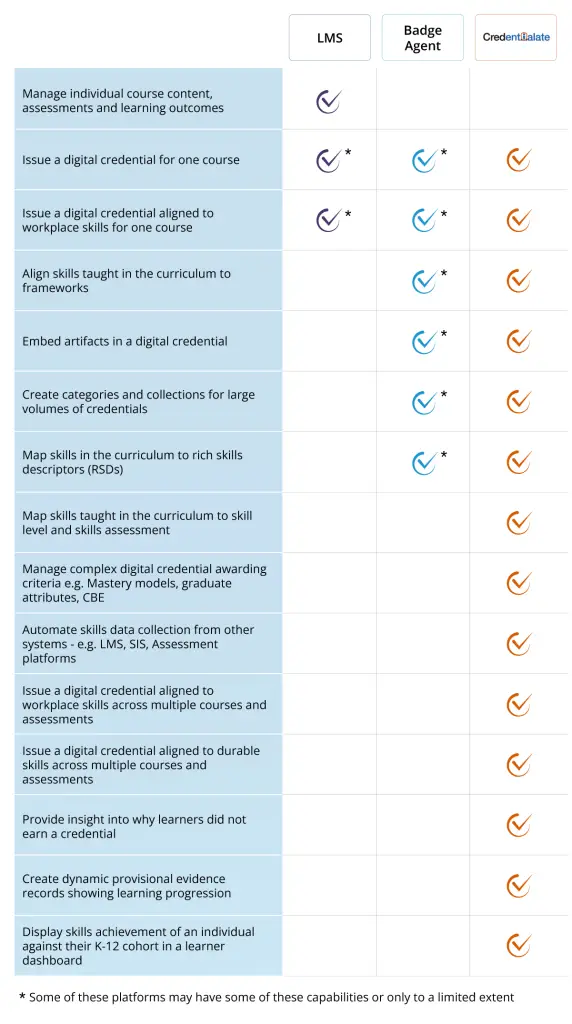
The primary difference between Credentialate and other systems is that it is designed to bridge data silos that often inhibit data movement and visibility. The unique ability to connect and map skills from different sources is key.
Once these connections are made, skills visibility suddenly comes alive. It enables skills recognition when there are complex awarding criteria – such as with Mastery-based, graduate attribute and competency-based education models – and also allows you to show learner progress, recognise durable skills, and workplace skills – hard skills tailored to specific career tasks.
Conclusion
Practical uses that move learners to become earners most efficiently are the solutions we are looking for.
It is imperative to consider what you need to provide your learners (particularly your adult learners) with to give them the confidence to speak about what they know and can do in hiring situations. Exposing the evidence is important – to both the learner and employer. Trust in the digital credentials you provide will come from transparency.
We must put evidence of skills in the hands of learners and that evidence must be easily verifiable and trustworthy. To get there from where we are right now is not a long, arduous journey, but a tech-enabled trip that is well worth taking.
Because learner-centricity is critical to the learner and earner of tomorrow, and therefore to the educators who will lead the way into this new era.
FAQs
- What does “learner-centric skills recognition” mean?
Learner-centric skills recognition is an approach that prioritises the learner’s perspective and agency in identifying, documenting, and showcasing their skills and competencies. It moves away from solely relying on institutional assessments and allows learners to actively participate in the recognition process. - Why is a learner-centric approach to skills recognition important?
It’s important because it acknowledges the diverse ways individuals acquire skills, fosters a sense of ownership over learning, and provides a more holistic and accurate representation of a learner’s capabilities to potential employers or further education providers. - What kind of “tools” are discussed in the blog post?
The blog post explores various types of digital tools and platforms that can facilitate learner-centric skills recognition. These might include ePortfolios, digital credentialling platforms, skills mapping software, like Credentialate, competency-based assessment tools, and platforms that enable the collection of diverse evidence of learning, like SkillsAware. - How can these tools benefit educators and institutions?
These tools can help educators gain a deeper understanding of student learning, personalise learning pathways, provide more meaningful feedback, and issue more valuable and verifiable credentials. For institutions, it can enhance their reputation and better connect learners with opportunities. - What are some of the challenges in implementing learner-centric skills recognition?
Challenges can include the need for professional development for educators, ensuring equitable access to technology, establishing clear standards for skills recognition, and fostering a cultural shift towards valuing diverse forms of evidence.