
This blog post was written by Rob Coyle and Margo Griffith in support of their 2024 ePIC Conference presentation and is republished with permission from 1EdTech.
On the first day at ePIC 2024, the 22nd annual convening focused on open recognition, we presented a session titled “Untangling the complexity: How can we unleash the potential of technology for recognition? How can we make recognition accessible for all?” What became clear, is the challenges facing digital credentials are complex, and people are hungry to talk them through and collaborate on finding solutions.
This session came from many conversations between the authors, centering on questions around the speed of adoption, efficacy metrics, and change management. The conclusion reached across all of these areas was “It’s complex!”…and…..We might be at a point in the evolution of the skills-first movement where the need for reflection is upon us. As John Dewey proposed “we do not learn from experience, we learn from reflecting upon experience”.
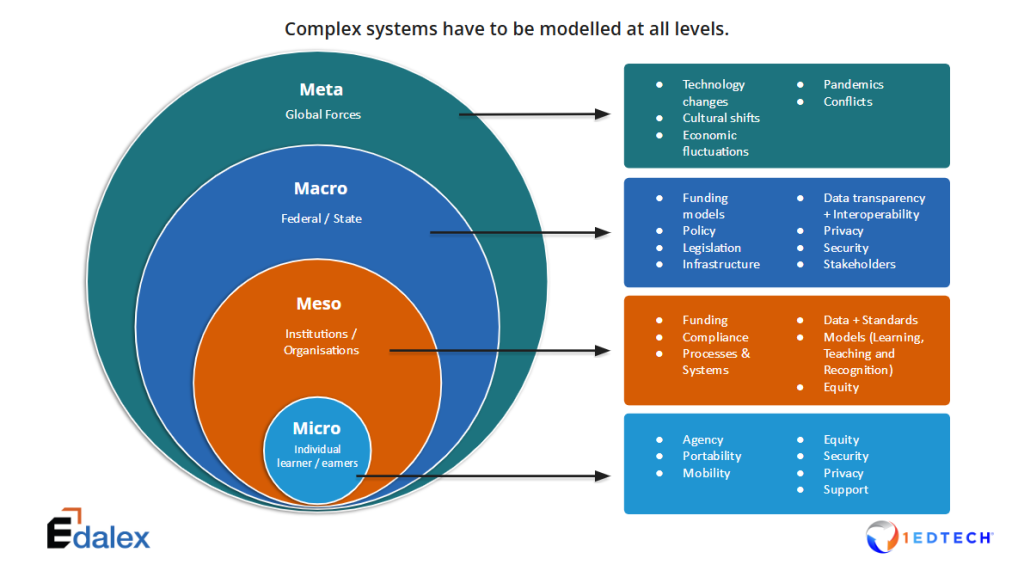
In response, our presentation began by unpacking the nature of complex systems. The skills ecosystem is in fact a large complex adaptive system (CAS), made up of embedded complex adaptive systems (such as formal education and employment systems). We wanted to emphasize that untangling complex systems requires this systems-thinking approach, with a recognition that the points of change lie in the connections (relationships between stakeholders) and the multi-layered nature of those relationships. We explored different levels of complexity, from micro to meta, and discussed the importance of tailoring strategies to address these various levels.
It was exciting to witness that as we delved deeper into this topic, there was a noticeable shift in the room’s energy. It became clear that participants were eager to share their experiences and insights (a side note for all conference convenors). The conversation quickly turned to practical challenges and solutions, highlighting the need for a more interactive and collaborative approach. We used Slido as the method for gathering insight from the session participants. Below is a snapshot of the responses with an important proviso – Slido truncates responses, so a number of them require some explanation, hence “Mike,” “Water,” and “door.” (see below).
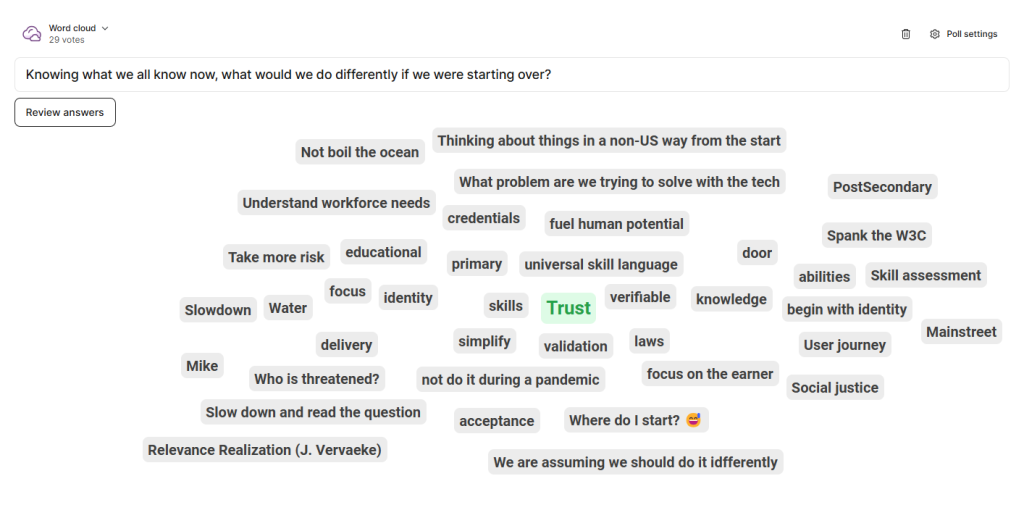

Posing the question “Knowing what we all know now, what would we do differently if we were starting over?”, overwhelmingly the participants kept coming back to the notion of trust. There was a mix of practical considerations and then more philosophical points that questioned the underlying assumptions of the skills-first approach. Many responses focused on putting the learner/earner at the center and truly designing for human potential. The term learner/earner is intentional as it was put forward that we have in fact focused heavily on the supply side (education) of the ecosystem with less engagement and design for the demand side (employers).
Preparing for our ePIC session, the authors themselves posed a series of questions as provocations:
- Are we trying to fix a broken system(s) or build a new one?
- Are we asking the wrong questions and trying to solve the wrong problems around skills-based learning and hiring?
- What can and can’t the tech do?… and what should and shouldn’t it do (esp. AI)?
- How do we design for human potential – like really?
- Is the availability of funding duplicating efforts because the problems have not been clearly defined?
- Language – does anyone not in the bubble understand what we talk about?
- Have we been so focussed in designing systems for scale that we missed the opportunity around the learner as the catalyst for change?
At this point, slides were abandoned and the conversation in the room became far richer and way more pragmatic. If we are to truly reflect on how far we have come and how to steer the ship forward, then coming back to some first principles might be required;
- We should focus on the why and spend less time in the boggy marshes of definitions
- We should be asking “should we?” rather than “can we?”
- We should be kind to ourselves and realise that the meta forces of the pandemic slowed the pace and introduced change fatigue
- We have to solve for all learning not just formal learning and not just post-secondary
- Simplify the message around impact not technology
- Remember this is a wicked problem globally
A recurring theme throughout the conference, and not just in our session, was the challenge of aligning rapid technological advancements with the often slower pace of program planning. This disconnect can lead to a variety of issues, such as underutilized technology, frustrated users, and missed opportunities for innovation. For example, many participants shared stories of technology-driven initiatives that outpaced the development of supporting programs, resulting in underutilized tools and frustrated users.
To bridge this gap and create more effective and equitable recognition systems, we emphasized the importance of a holistic approach that considers the entire ecosystem, including people, processes, and technology. By fostering collaboration between technologists and program planners, we can ensure that technology serves as an enabler, not a barrier, to accessible recognition.
Key takeaways from our session include:
- The Indispensable Role of Human Connection: Despite technological advancements, human connection remains essential in building trust, fostering collaboration, and inspiring action. Strong relationships between individuals and communities are crucial for the successful implementation of recognition programs.
- The Power of Storytelling: Sharing personal stories can help to bridge divides, spark empathy, and catalyze change. By sharing our stories, we can inspire others, build a sense of community, and create a more inclusive and equitable world.
- The Need for regular reflection and adjustment for impact
- Research Enhanced Approach: Real opportunity to critically examine how we move forward with robust research, a fuller systems map and strong implementation guardrails.
We believe that by embracing these principles, we can untangle the complexities of recognition and create a future where everyone has the opportunity to learn, grow, and achieve their full potential.
Many of the participants expressed their comfort with operating in the “messy middle” since that is where we see a lot of innovation happening, but by nature of being messy, we need to be intentional about collaborating so we can safely navigate the middle together.
|
Rob Coyle As 1EdTech’s program manager for digital credentials, Rob Coyle is committed to expanding the success of digital credentials with Open Badges and the Comprehensive Learner Record Standard to support learning and acknowledge the skills and competencies mastered through formal and informal education and life experiences. Rob recognizes the limitless opportunities that arise from meaningful discussions between education institutions, edtech suppliers, and learning providers to understand the needs of all stakeholders. Rob brings his experience working with a wide variety of educators and edtech suppliers from K-12, higher education, and corporate training and development. Rob’s career as a teacher and collaborator with other educators allowed him to help learners acquire knowledge and develop new skills through meaningful learning experiences in various disciplines. Rob is an avid supporter of meeting learners where they are and recognizing that not all learning occurs in a classroom with a textbook. These experiences made Rob an avid supporter of the open community, including open-source technologies and open education resources. Rob graduated from Goucher College in Baltimore, Maryland, with a Master of Education degree focused on education administration and edtech administration. |
|
|
Margo Griffith Margo’s in-depth knowledge and experience of skills, the skills ecosystem and digital credentials is the result of working in and with higher education providers and edtech leaders, nationally and internationally for over 30 years. She is passionate about the positive impact of technology within education and the enablement of lifelong learning, learner agency and mobility. Margo co-convenes a Cross Sector Community of practice around Micro credentials in Australia and consults with Government, industry and education sectors around a skills first approach to learning and workforce. Her recent publications include “Creating the University of the Future: A Global View on Future Skills and Future Higher Education” (Contributor) (Springer 2024) and “Technology Enablement of the Skills Ecosystem” Naomi Rose Boyer and Margo Leanne Griffith (International Journal of Information and Learning Technology ISSN: 2056-4880, 2023). |
|