Tag: skills data

  • WEBINAR RECORDING: The Learner Voice – Why Skills Visibility Matters

    WEBINAR RECORDING: The Learner Voice – Why Skills Visibility Matters

    Wed, 6 May | 7:00 am AEST

    (Tue, 5 May | 5:00 pm EDT)

    (Wed, 6 May | 2:00 pm PDT)

    Duration: 60 minutes

    Where: Webinar (Online)


    Watch the webinar where we move beyond technical acronyms to hear the most important perspective in the skills ecosystem: The Learner.

    (more…)
  • Navigating AI’s Impact on Education, Workforce, and the Future of Skills Recognition

    Navigating AI’s Impact on Education, Workforce, and the Future of Skills Recognition

    In this wide-ranging conversation, Dan McFadyen (Edalex & SkillsAware) sits down with Ray Fleming (Founder of Stratentia) to explore AI’s impact on education, workforce readiness, and the future of skills recognition.

    Ray shares his “two-speed” analogy – where AI evolves at lightning pace while education moves more cautiously – and examines the growing tension between institutional change and employer expectations. The discussion unpacks why AI fluency is becoming essential for graduates, why durable human skills like critical thinking and communication matter more than ever, and how AI should serve as a tutor – not a teacher.

    They also explore the urgent need to rethink credentialing beyond traditional degrees, highlighting the rise of STARs (Skilled Through Alternative Routes) and the shift toward employer-aligned skill validation. For organisations, Ray outlines the three phases of AI productivity – personal, process, and paradigm – emphasising governance, experimentation, and leadership communication as critical enablers.

    Looking ahead, the message is clear: the winners won’t be those who use AI just for efficiency – but those who use it to drive growth, innovation, and deeper human connection.

    Watch the Full Interview

    Chapter videos

    Click on the videos below to view or watch on our Channel Edalex YouTube channel – Subscribe to receive updates on new videos:

    Dan and Ray Fleming  dive deep into the massive implications of Artificial Intelligence on education, the workforce, and skills recognition. Ray uses the powerful “ski lift” analogy to illustrate the tension between fast-moving AI technology and the slower pace of change in educational institutions. They discuss why essential human skills – like critical thinking and communication – are more critical than ever, and how organisations must adopt governance and a growth mindset to navigate this change successfully.

    Dan and Ray address the challenge educational institutions face in keeping pace with rapidly evolving AI technology. They agree that AI’s initial value in learning will be as a tutor, not a teacher, but that institutions must adopt a strong governance framework to manage the speed of change. They discuss the pressure from employers who seek graduates with deep AI fluency, alongside essential durable human skills like communication and critical thinking, to help build new business models.

    The discussion tackles the urgent need to credential “durable skills” like critical thinking and communication in the AI age. Ray shares his experience as a STAR (“Skilled Through Alternative Routes”) to argue that traditional degree requirements are obsolete filters that exclude talented candidates. Dan and Ray then pivot to corporate strategy, where Ray outlines the three phases of AI productivity – from simple efficiency to building entirely new business models – and stresses that organisational governance is the essential first step for fostering responsible staff innovation.

    The discussion is around the crucial strategic steps organizations must take to successfully integrate AI. Ray identifies the lack of governance and a culture of learning as the single biggest mistake companies make, emphasising that staff need safety and security to innovate responsibly. The discussion outlines the three phases of AI productivity, urging leaders to move past simple efficiency (Personal Productivity) toward “Paradigm Productivity” – the creation of entirely new, transformative business models.

    In the concluding chapter of their interview, Ray offers practical advice for successfully navigating the AI future and gazes into the crystal ball for the next 3 to 5 years. They stress that organisations must view AI as a growth lever, not just an efficiency tool, and emphasize the critical importance of embracing a culture of experimentation and communication at the leadership level. Ultimately, the future belongs to those who double down on human connection and use AI to extend, not replace, their own cognitive abilities.

    Transcript

    (This transcript has been lightly edited for readability)

    Chapter 1: The Evolution of AI and the “Two-Speed” Challenge

    In this insightful interview, Dan McFadyen (Co-founder & Managing Director at Edalex and SkillsAware) and Ray Fleming (Founder of Stratentia) dive deep into the massive implications of Artificial Intelligence on education, the workforce, and skills recognition. Ray uses the powerful “ski lift” analogy to illustrate the tension between fast-moving AI technology and the slower pace of change in educational institutions. They discuss why essential human skills – like critical thinking and communication—are more critical than ever, and how organisations must adopt governance and a growth mindset to navigate this change successfully.

    Dan McFadyen: Hi, I’m Dan McFadyen, Co-founder and Managing Director at Edalex and also Director at SkillsAware. It is my great pleasure to be joined today by Ray Fleming. Ray is the Founder of Stratentia. He says that’s not the most interesting bit of his background—and he does have other interesting bits—but we’ll come back to that. Ray has been the Higher Education lead for Microsoft Australia and Google Cloud’s Global Solutions lead for education, and in the last few years, he has been very focused specifically on AI. After four decades of being fixated on technology and education, Ray compares it to sitting on a ski lift where your legs and body are moving at two very different speeds: the lightning-fast leaps into the unknown with technology alongside the careful and thoughtful pace of change in education. I love that comparison and we’ll come back to that as well, Ray. But thank you so much for joining me today.

    Ray Fleming: Yeah, thanks for the invite, Dan. It’s always great having a chat with you.

    Dan McFadyen: Yes. Yes, we do go back a number of years and had the chance to collaborate on a few things. So, yeah, really looking forward to diving into our discussion. And again, we will talk a bit more about Stratentia. But having that great breadth and depth and length of experience certainly builds to the perspectives that you’re able to share with us today. And yes, you have been exploring AI for quite some time—more than six years, nearly six and a half years with your “AI in Education” podcast with Dan Bowen—and you claim to have read 250 research papers. I’m curious whether or not AI did the reading for you. But yeah, why did you do that? And let’s give us some context and what have you learned from 250 research papers?

    Ray Fleming: Yeah. Okay. I’ll fess up about the research papers a bit later. So first of all, the context for the podcast: six and a half years ago, I was at Microsoft, and one of my colleagues, Dan Bowen, was at Microsoft and we got into this conversation. We said, “Hey, we should talk about something with a microphone.” I mean, typical middle-aged bloke. But would you believe it? We picked the most boring topic in the world to talk about: AI and education. At least six and a half years ago it really was, because it was super geeky. It was all about how AI algorithms were able to do things like predict student dropout—it was that kind of stuff.
    None of us knew that halfway through the lifetime of it up to now, this thing would appear where AI suddenly escaped from being the geeky thing that people knew, but nobody knew how to do. You’d sit at a meeting with people and say, “Surely we can build personalised learning plans.” In fact, I went back to the OECD report from 2021, and they were talking about adaptive learning systems, student retention systems, and using blockchain for credentials. I’m pretty sure that when you were having those conversations, you’d be in a room with six or eight people, and down the other end of the table was somebody with a hoodie and you didn’t know which department they were from. They didn’t say very much, but they were the person that went and did things—the one person who understood what you’re talking about. They were the geeks or the nerds, whichever is the polite way to go.
    That was the world of AI as it was six and a half years ago. Even if I think back to my first AI course, which was maybe ten or twelve years ago, I was learning about statistics and linear regression and all that kind of stuff; all of that is forgotten now. Because we’re now in this age of human AI where the skills you need to interact with it are the same as you need to be able to interact with humans. I haven’t done my check to check that you’re a real Dan rather than a digital Dan, but you know, we’re kind of getting to that stage now where everyone can get their head around it.

    I think we’re still in a stage where there is a lot of misinformation because of a misunderstanding about things. Everybody has got a different perspective about what AI is. Let’s go back 2000 years to the story from India of the blind man and the elephant. If you take the blind man to the front of the elephant, he says it’s a tree trunk; if he’s taken to the middle, he says it’s a wall; and if you take him to the back and you’re lucky, he says it’s a rope. That’s AI for me. Everybody has a different perspective on what it is. It’s an answer machine; it’s the equivalent of Google search; it’s a lifelong companion; it’s a romantic partner; it’s a thing that summarises research papers for me. It’s got all of these different use cases and people have different perspectives. So we’re just like any community or organisation: there are lots of blind people touching one part of AI, not aware that there’s lots of other stuff to it.

    Dan McFadyen: Fascinating. Yes. Well, and I think if you can extend that analogy and think about how quickly that elephant is changing, right? So, suddenly, is it a camel in the middle and you feel that hump on the top? Let’s talk about that in the context of the research papers.

    Ray Fleming: So yeah, you’re right. I’ve read 250 research papers. What I’m trying to do is keep abreast of the research coming out about the impact of AI in education, what’s good practice, what’s bad practice, and what case studies are out there that are informative and evidence-based. So I read a stream of research reports. Now, my reading of research reports is not the way that you’re taught to read them academically. I once read a guide about how you’re supposed to read research reports: you read them once, then you go back and read them again with a new understanding, and then you go back with questions and read them again. It basically takes four hours to read a research report properly. So, I think the maths tells you I have not read 250 research reports that way.

    But what I’ve done is I’ve trained AI to read research reports for me the proper way. Then it does two things. One is pulling out the key information, but then the second is making it relatable to human beings, because I’m not an academic language person. I find that research papers tend to hide the interesting stuff. There might be interesting stuff on page 14 rather than in the abstract. They also hide it behind complex academic language. When we talk about this stuff on the podcast, I’m talking to, you know, a teacher in a classroom who’s got 20 minutes to listen to a podcast on the way to work. So it’s got to be pretty clear.

    I use AI to help me in that translation process. But I read way more papers than I probably want to because I’ll look at that information I get from my analysis and then think, “That doesn’t seem quite right,” and then I dig into them. Often I’m reading the research paper before it’s been published in a journal. The reason for that is this technology is moving so fast and research publication processes are so slow that it’s out of date by the time it’s been published. If I can see the preprint, then we can use that straight away. I’m still seeing research papers published today that tell me AI can’t do something based on AI from 18 months ago. That’s like talking about a toddler not being able to walk when they are now much older, because this stuff is changing so fast.
    Dan McFadyen: That’s right. When we’re actually thinking about having this interview in December last year, and then wait—December to January is too late, right? Things will have shifted.

    Dan McFadyen: So let’s talk about that analogy of riding that ski lift where technology is heading one way and the educational institution body is heading the same way, but at a much slower pace. I’m sure your answer to this question 18 months ago would have been very different in terms of how institutions are handling and leveraging AI. On your podcast last year, you interviewed and referenced the great example of University of New England and what they’ve been doing with AI. Are they the future and everyone will follow that model? Are they the exception? And for those that aren’t following that model, what’s holding them back?

    Ray Fleming: So I think we’re seeing two or three things happening. One is we are seeing big, important educational institutions making a decision that they have to put AI into the hands of their staff and students. Take one of the top universities in the world, Oxford University. Oxford said we are going to put ChatGPT Education into the hands of all of our staff and students. I’m not sure if they know how they’re going to use it yet, but they know that it’s important to do that in order to start making change. Then a few weeks ago, they said they’re going to put Harvey into the hands of all of our law students. That’s really interesting because it starts to show how it is affecting different professions.

    There is an expectation from employers that our students will have the skills they need for the workplace. And let me be frank, for a lot of employers, AI skills are now something that are needed for the workplace. In fact, I know of employers where, if your answer to how to use AI is “I don’t,” you won’t get a job there. If you’re a lawyer in the future—and for many law practices now—you will need to be using AI systems. Harvey AI is the biggest legal AI system, and they’re using that in the law school. They’re doing it in some Australian universities as well. That is driving the connection between academics and learning and the workplace, which we know has always been there. It’s been stronger in vocational education than it has been in higher education, but I think that tension from the two-speed change is going to pull the elastic so tight that it’s going to spring back really fast.

    Dan McFadyen: Right, right. Well, and it’s an inevitable disconnect if you suddenly have been taught that this tool is cheating, right? You’re not allowed to use this tool, yet it is a fundamental tool for your job. You can’t do your job without it. This is an incredible dichotomy for education and the purpose of learning.

    Ray Fleming: While learning is supposed to be difficult—it’s like going to the gym. You go to the gym in order to lift weights, not to watch somebody else lift weights. Learning is a bit like that. You’ve got to go through the hard work of working out how to structure an essay and how to get your ideas expressed well. But then when you go out to the workplace to do exactly the same tasks, you probably use AI to help you draft the report and all those things. So you’ve got to differentiate between how AI comes into the picture in order that people have the right skills for employment, but without killing their ability to go through the hard work of learning.

    I think there’s a bit of a technology rule here: if you’re under the age of 16, AI should never give you the answer. It should always be Socratic with you. But then the other part of it is how do we motivate learners to realise that they have to go through this difficult process rather than switching off the cognition and letting AI do the work? We’re in Australia; maybe a 15-year-old rugby player would understand the gym analogy more than they would understand the AI analogy: “don’t go to the gym and have your personal trainer do the lifting for you.”

    Chapter 2: Addressing the Disconnect Between Education and AI Readiness for the Workforce

    Dan McFadyen: Yes, great context. So from your experience working with a number of different universities and seeing the space, are our universities getting it? Are they becoming innovative, or are they falling hopelessly behind in some cases?

    Ray Fleming: I don’t think that anybody is falling behind. It’s just that perhaps the pace of change has moved up. I only think about AI every morning and try to find out what’s happened, and I can barely keep up. So how can a system or an institution keep up? We’re still in that stage where it’s emerging technology and new use cases are being discovered every day. It is difficult to keep up, but I think that we’re starting to see some areas where it is becoming clear that it’s got a genuine benefit for the education process.

    I think one of the most important first use cases agreed across education will be AI as a tutor, not as a teacher. I honestly do not believe that AI is ever going to be able to replace a teacher because a teacher does way, way more than give you information. But AI as a tutor—I think we’re going to start seeing a lot of focus on those use cases. Other use cases will come along and that will help us to say, “This is the positive role it can play in education,” and we can start to nudge out all of the negative roles or the ways that it can cause us to feel like we’re moving forward when we’re not. The challenge for the education system is how do you keep up with all of that? It’s probably easier when you’ve got an 18-plus audience, but if you have vocational education where students are starting at 14, 15, or 16, it’s a very different world regarding how you provide resources and facilities for them. That governance piece is really important.

    Dan McFadyen: Yeah. And obviously there’s a lot to dig into on that, but that’s encouraging, your broad view that institutions aren’t falling behind. I do wonder about the urgency and immediacy of expectations of consumers, right? Who has the time to go to a three or four-year undergraduate degree when they can do a bootcamp or an accelerated work-integrated learning blended model? It will be interesting to see how that evolves—just these expectations of “Well, I can learn all that” or “I don’t have to learn, I can just use my assistant here.”

    Ray Fleming: Yeah, I think it puts some real pressure on the education system because of that mismatch potentially between the learner, why they are coming to university, and the employer. The number one reason people go to university is to get a better job. I know that there are lots of other reasons and socioeconomic factors, but the number one reason is to get better employment chances. Part of that then has to link to the skills they need to be able to sit in front of an employer and show it’s not all about technology. There’s this very basic skill that is now being looked for by employers.

    I believe in a couple of years’ time, the perfect recruit into graduate programmes for employers is the student that really, really understands technology and is the smart one that knows how to use AI. If I’m a law firm, I’ll pair them up with my crusty 60-year-old lawyer that thinks technology is a waste of time, because that lawyer has deep experience in the industry and the use cases. I’ll pair them up with a 21-year-old that knows no barriers and has no limits to what they can imagine is possible, and they’ve got this AI tool to help them do it. That will be the brilliant combo. It may not matter that they don’t have much experience in law today. In the last few years, those people might have been hired just to go and do research, but maybe now they’ll be hired to build the new model of what a law practice, an accounting practice, or a management consultancy will look like.

    The graduate in a year or two’s time will have learned so much about AI, either because the education institution helped them or because they’ve helped themselves. There was a case a couple of years ago of a student in Turkey who was found cheating in their university exams. They had integrated a camera into their glasses, an earpiece, and an internet hub in the heel of their shoe. The camera was looking at the exam paper, sending it to the internet hub, then out to an AI system that was reading the question and giving them guidance in their ear. That student got caught and expelled. I reckon there would have been a pile of employers waiting at the exit door to hire that person because that’s the kind of innovation and efficiency that you want as an employer! It doesn’t match with the education experience because we’re trying to do something different, but those are the two worlds.

    Chapter 3: Assessing and Credentialing Durable Skills in the Age of AI

    Dan McFadyen: That’s great. I’m not sure if that’s the modern-day Maxwell Smart or Mission Impossible, but that concept of not having boundaries is key. You’ve talked about the transition to the workplace, so I’d love to pull that thread a little bit more and talk about skills in an AI future—what skills are important today and moving forward, other than being able to put an internet hub in your shoe?

    Ray Fleming: I think the essential human skills become more important: collaboration, communication, critical thinking. Those skills become much more important because, as I’ve experienced frequently, AI will take my dumbest suggestion, tell me it’s brilliant, and tell me how to implement it. Or I’ll ask a question and it will give me a well-reasoned, five-page paper full of rubbish because I’ve asked the wrong question or it’s misinterpreted things. All of those critical thinking and communication skills come back as being really important because I need to be able to dig further into the support it is giving to me, in the same way you do when you work with an intern. The intern scuttles off and does something for you, but they come back and you go, “I know you interpreted my request like that, but actually I didn’t want a spreadsheet, I wanted this.”

    The challenge for the education system is that we have maybe focused a lot on fact retention and recall, and we’ve drifted away from essential human skills because they are a lot more difficult to assess. I’d argue we probably worried that the assessment has been subjective rather than objective. I’m going back about 25 years ago to a conversation with the chief examiner of exams in the UK. They were very driven around objective assessment. Then I explained how recruitment happens in the commercial world. At Microsoft in the UK, we used to interview 1500 potential graduate hires in one day with a panel of maybe 25 people. In 20 minutes, I would subjectively make up my mind whether that person was the right fit. Probably in the first 20 seconds, actually! We’ve all done that, haven’t we, Dan? You’re interviewing somebody and you know you’ve got to make the interview last 20 minutes, but you already have an indication.

    We’ve lost a bit of trust in the education system and educators to be able to make those judgments for us, so we’ve added big, complicated assessment systems. How do we get back to being able to assess what are now critical skills? They’re not “soft” skills; they’re actually critical skills because those are the skills that are going to survive the AI apocalypse when AI starts doing other parts of our jobs. How do you assess them, certify them, and communicate them? Today, the only way that is communicated is in a job interview where somebody talks about what they’ve done before with passion, not just from a piece of paper.

    Dan McFadyen: Right. I love where you’re taking this. There was a really interesting report that the World Economic Forum released last month called “New Economy Skills: Unlocking the Human Advantage.” They talked about “durable skills”—human skills. They made a fascinating point that human skills aren’t necessarily durable by default. They have research charting a decline in those skills during COVID when we weren’t interacting or working with people, and then they’ve come back up since. It raises the question: not only how should educational institutions be assessing this, but how should they be training learners on this? Should that come from formal education, or is the reality that we gather that from life—non-formal and informal learning, work, hobbies, and passion projects?

    Ray Fleming: If you’ll excuse me, I’m going to relate this back to AI because I only think about it when I wake up in the morning!

    Dan McFadyen: I’m guessing you’re running this whole discussion through ChatGPT and it’s coming up on a teleprompter in front of you, right?

    Ray Fleming: Oh, I’m not sure even the worst model could be as dumb as me with some of the things I say! There are two ways to think about using AI. One is: “I’ve got this task, help me with this task.” The other is to see it as a true thinking partner. It’s not a tool like a pencil; it’s something that I can use to help me increase my cognitive ability and think about things I wouldn’t have thought about, or get past brainstorming blocks. The skillset isn’t as easily teachable because it’s not just a specific technique; it’s having another form of intelligence alongside you. Often people ask me how to get it to help with a specific task, but actually, it’s generalisable. If you know how to do a critical assessment of something, you could apply that to a research paper, your shopping list, or a colleague’s performance. AI skills are about having the ability to generalise rather than just knowing one technical task. It’s not like a spanner where if you’ve got a nut-shaped thing, you know you need a spanner. It’s about how do I use this to help me get somewhere?

    Dan McFadyen: Fascinating. And that report I mentioned has a call to action around how to develop, assess, and ultimately recognise or credential these 21st-century durable skills. They identify three phases: assessment, development, and credentialing—trying to get a sense of the whole human beyond what they can do in terms of a paper test. This is something that’s near and dear to my heart and both Edalex and SkillsAware. Do you see AI in all of that, or is there some of it that doesn’t belong? You’ve talked about tutoring, not teaching, but the tutor role.

    Ray Fleming: As an employer, we often use one signal as an indicator of a whole lot of other things. For example, many job ads require a degree. It’s not because the job specifically requires those academic facts; it’s because we want to filter out a bunch of people so we only have 100 applicants to look through instead of a thousand. It gives us a signal that they probably have the tenacity to get through a university course. There are jobs where it is required—accountants or lawyers—but if you want to be a Chief AI Officer, a piece of paper isn’t what you need.

    Let me demonstrate with a personal example. In all of the roles you talked about that I have done, a basic requirement has been an MBA. Every job I’ve done in the last 15 to 25 years has had an MBA as a requirement. I don’t have an MBA. I don’t have a degree. So I don’t meet the criteria on paper, but I very clearly met the criteria to be able to do the job because I’ve done those jobs. I was doing some work with a large financial institution that said they were having difficulty finding candidates. I put myself into their candidate system for a job that I could do tomorrow. It took them less than 20 seconds for the system to say, “Oh, we don’t have anything for you.” I know it’s because they checked some lines and I didn’t meet those lines.

    The credential system, as opposed to the qualification system, is how an employer and employee get matched. Education certifications have become a proxy for those skills. I would argue 80% of the people my age do not have a degree. If you’re an indigenous person my age, the proportion is less than 1%. So if you are recruiting somebody 50 plus, the fact that they didn’t do this thing 35 years ago isn’t relevant. But asking for it automatically disqualifies the people you say you want to hire. If you’re not attracted to a new way of credentialing people, then perhaps the risk of using the old way might be an incentive to think about the new way. To answer your question about AI’s role: AI could have a role in performing more objective assessments of things like communication, critical thinking, and collaboration in a way that is much more cost-effective.

    Dan McFadyen: Thank you for sharing your own story. I think your tenacity is an example of someone who has been able to succeed and get around obstacles that employers unknowingly put into place. You’re part of what is known in the industry as a STAR—someone who is “Skilled Through Alternative Routes.” In America, that’s more than 70 million people. The challenge is, if you have 1500 candidates and you can win it down to a more manageable list through applicant tracking systems, you’re screening out great candidates. We’re moving into a post-technology economy where your ability to know facts isn’t as important as your ability to apply them. Does that change the role of education and certification? Are there different skills or pathways STARs should explore, or does their real-world experience give them the advantage so that this becomes less of an issue over time?

    Ray Fleming: I think the answer is going to become employer-led. The opportunity for the education system is how they get aligned with employers. In the tech world, one of the most valuable qualifications to get a job is a Microsoft or Cisco certification. That has traditionally been done outside the education system, but because it’s linked into the employer model, an employer knows that person definitely has those skills.

    For durable skills, does the education system and the employer have to come together to say, “Okay, we can agree on what good looks like”? Because today, I suspect an educational institution’s view of what good communication looks like and an employer’s view are in different places. I’d even contextualise it—is it in a medical setting, retail, or business? I remember working with a childcare provider who said the standards haven’t changed, but the employees coming through the door with certifications don’t meet the same standards people did five years ago, so they have to train them directly. You’ve got to close that gap. Maybe instead of focusing on things that have been around forever, we do that for skills that haven’t been credentialed in the past, like critical thinking. Who can create that certification that has the confidence of employers?

    Dan McFadyen: I know organisations like the Council for Aid to Education out of the U.S. have performance-based assessments to surface evidence of those durable skills, and it’s not your typical multiple choice. It’s interesting to think about how AI might help. When the first crisis wave hit and we couldn’t trust the words a student wrote, there was discussion about whether AI could do the reverse and perform conversational assessments.

    Ray Fleming: Yeah, which education organisation has the ability to make that happen? Or does it have to be, I don’t know, the “KPMG standard for communication” that then becomes adopted more broadly? If I was a credentialer, how could I get a bunch of employers to validate this? That is exactly how the legal, accounting, and engineering professions work. University credentials in those fields have all been done with industry. Someone is going to come up with the critical thinking credential.
    Dan McFadyen: Coming back to technical skills—if I see someone has AWS or Azure certification, I trust that. But if someone just graduated and they’re going to become a junior programmer, they’ve likely been taught computer languages that are five years old or older. We have less trust in that as an indicator of someone who is ready for the team.

    Ray Fleming: So we have a double challenge: how we recognise those skills, and how we apply AI to help recognise them when we don’t know exactly what AI can do or how it’s changing. A wicked problem! But I think it’s the obvious way to go. In five years’ time, we hope to have a solution. You can’t solve it all today, but you can move in the right direction. That’s very different from the past where we pinned everything down before we started. It’s a compass, not a map. I can’t show you exactly which roads you’re going to go on, but I can tell you the direction of the destination. We will discover infrastructure as we go.

    Chapter 4: Strategic AI Implementation – Governance and the Three Productivity Phases

    Dan McFadyen: Perfect. Now, let’s pivot the discussion a little bit. We’ve talked about AI in education and the workforce. I’d love to get your perspectives through your work at Stratentia and RockMouse. You help organisations integrate AI into their business and workflows. What is the single largest mistake you see organisations making when they’re trying to jump into AI?

    Ray Fleming: Most organisations are currently at the “personal productivity” level—everyone using AI, but no longer having to hide it like they did 18 months ago. Those big glowing case studies we read, like Klarna replacing 700 people in call centers with AI, are the exception rather than the rule. Don’t worry that you’re missing out, but do worry if your organisation hasn’t got a culture of learning and a set of governance so your staff can be confident they are doing the right thing. I’ve been doing a lot of work around governance, including helping create a governance pack for RTOs (Registered Training Organisations) in Australia.

    Getting governance in place is important because currently, staff are individually carrying the stress of using these tools without knowing if they’re allowed to. The answer isn’t to ban it, because everyone will just do it at home and the data will leak out anyway. Unless you’re a bank with a super controlled environment, everyone is doing AI in some way. Give them safety and security, but don’t make it ownerless. The first mistake is not having governance; the second is not recognising that we’re all on a learning journey. IT teams have a lot to learn because AI projects are very different from conventional IT projects. I’ll often engage with a leadership team, and then the board, the risk team, and all the staff need to know. It’s not onerous; it’s just about giving two signals to your staff: “We want to enable you to be innovative” and “We want you to use AI responsibly.”

    Dan McFadyen: That’s great. I was reflecting on our own journey at Edalex. In any company, you have early adopters and those who are resistant. We’ve encouraged people to show examples of AI innovation in their own roles during our monthly all-hands meetings. We’ve had some say AI doesn’t help them, but more and more are saying there’s no way they could do their job without it. You mentioned most people think about it as productivity versus transformation. Where do you see that balance shifting? Are we transforming how we work, or are people just using it to catch up on their inboxes?

    Ray Fleming: I think of it in three phases: Personal Productivity, Process Productivity (teams and organisations), and Paradigm Productivity (completely new business models). Uber is paradigm productivity—starting from what the customer wants and designing a new process. In organisations, the “process” bit can be tricky because many have suboptimal processes grown over years with manual tweaks where the team provides the “glue” between gaps. If you don’t understand that, you either automate a terrible process with AI or the process breaks because you didn’t realise that human glue was happening.

    Don’t just automate your existing crappy processes! If you do, your project will likely fail. Regarding the “paradigm” model—which organisation is going to vote for themselves to become redundant? A new model of higher education probably isn’t going to come from an existing faculty; it will come from a startup or an innovation unit that doesn’t have to follow all the old rules. In Australia, we have regulators like TEQSA and ASQA, but the rules can be interpreted in more than one way while remaining compliant. People just need the space to do that. A year ago, I said I wanted to help 100,000 people work out how AI can change their industry. Helping them make a living out of it is more of a challenge because it’s not yet very solid. I think about “AI fluency” rather than just “literacy.” For a leader, fluency is knowing what AI can do now and in the future to adjust how an organisation is structured.

    If we can use AI to handle the tasks that usually get pushed to next week’s action list—the important but not urgent things—that is awesome. Those organisations will grow. This isn’t just about needing fewer humans; it’s about organisational growth and doing the important stuff we never get to.

    Chapter 5: Practical Advice for Navigating the AI Future

    Dan McFadyen: I love that multi-tiered model. I’ve taken a lot of your time, but I have two questions remaining. You mentioned the relentless pace of change, yet people are largely resistant to change. How do we make sure our legs are not going off in one direction while the rest of our body and our education is somewhere else?

    Ray Fleming: Two things: Experimentation and Communication. Instead of asking if AI can do something, have a crack. I got a data file from my electricity company—800 lines and 100 data points on each line from my smart meter. I wanted to work out my energy usage, so I gave it to Gemini and said, “This is my file, tell me the story.” AI gave me an amazing story that let me work out that a couple of devices were running overnight that I had no idea about. It gave me the economics of a battery and everything. I saved about $500 on my electric bill in three days! It cost me 30 seconds to ask. So, just have a crack.

    Second, for people at the top of organisations: talk about how you are using AI. It gives people ideas, but more importantly, it gives a clear signal that you think it’s a good thing. They will then open up to possibilities. Talk about it to inspire others. That’s the way to get the group that hates AI to diminish. It’s important to respect their opinions, but there’s too much untapped opportunity.

    Dan McFadyen: My final question is the “crystal ball.” Looking 3 to 5 years down the road, what is the impact of AI? I say this in the context that overnight AWS announced they are laying off a large number of people, and graduates are not being hired in some parts of the legal profession. Is it going to transform our economy or trash it?

    Ray Fleming: It could go either way. When I sit with a board, I’m looking in their eyes to see if they see this as a growth lever or just an efficiency lever. If you’re an education institution, can you deliver learning in a different way? Could you refocus your team on interpersonal delivery rather than content development? Could you deliver transnational education in seven languages at once? That’s the growth opportunity. The other is the economic opportunity: “Do we need fewer people? Can we replace teachers with bots?”

    Over the next five years, I think the survivors will be the ones who go for the growth opportunity. Content isn’t king; human connection is king. Human connection is what delivers a brilliant educational experience. Double down on that. AI can enable you to do that by removing the obsession with backend processes or manual curriculum plans. You get brilliant plans from AI, but the brilliance is in the delivery excellence.

    Dan McFadyen: Excellent. I was at an EduGrowth Clearpath CEO Syndicate recently and we had a vibrant debate on this—some say government will step in to make it illegal to fire people, others say the world as we know it is done in five years. I like your optimistic view that individuals and organisations can make a difference. What is your final piece of advice?

    Ray Fleming: Don’t let AI switch your brain off. Use it to extend your brain rather than replace it. It’s a bit like social media—it shouldn’t replace all your personal connections, though unfortunately for some, it has. AI could be the same. There will be people that use it to extend themselves and others that use it to replace themselves.

    Dan McFadyen: Wonderful. So many thought-provoking perspectives today, Ray. Thank you so much for your time. How can people find your podcast?

    Ray Fleming: The podcast is easy to find—just search for “AI in Education.” You’ll either find an episode where we interview someone fascinating or a conversation between Dan Bowen and me about the latest news. We alternate weeks. Some say the interviews are great, some say the research interaction is great; I’ll let the listeners be the judge. The easiest way to find me is on LinkedIn—just look for Ray Fleming.

    Dan McFadyen: Wonderful. Thank you so much for your time today, Ray.

  • Learning Agents announces an exciting suite of technologies to revolutionize skills recognition in Canada

    Learning Agents announces an exciting suite of technologies to revolutionize skills recognition in Canada

    Learning Agents, a leading Canadian company connecting skills performance with careers through the recognition power of digital credentials, today announced the launch of CanSkills.ca, a world-class suite of connected technologies to revolutionize evidence-backed skills recognition in Canada. This growing partnership brings global digital recognition technologies to Canadian servers, adapted to local Canadian needs, delivered by Canadians for Canadians.
    (more…)

  • Edalex Achieves Historic Sixth Consecutive Placement in Prestigious HolonIQ Australia & New Zealand EdTech 50

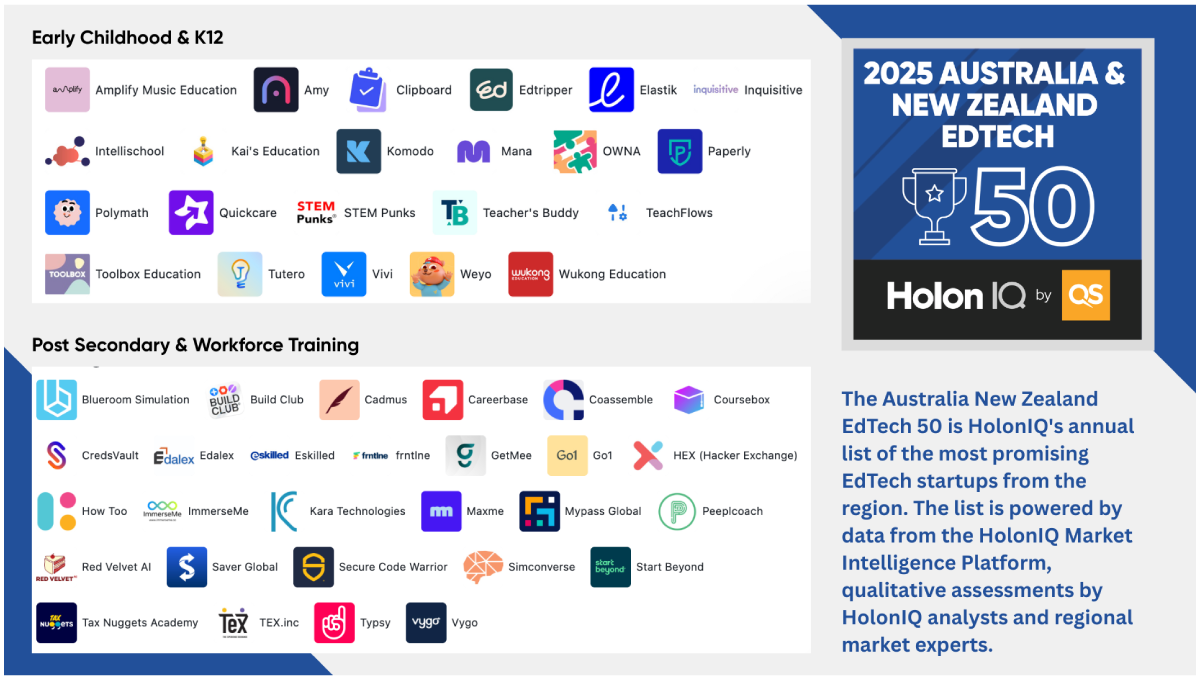
    Edalex Achieves Historic Sixth Consecutive Placement in Prestigious HolonIQ Australia & New Zealand EdTech 50

    Edalex, a leading provider of EdTech solutions that connects learning, skills, and evidence, today announced its selection in the 2025 Australia & New Zealand EdTech 50 list by HolonIQ, a leading global market intelligence firm for the education industry. This marks the company’s sixth consecutive appearance on the influential annual list, a recognition of its sustained impact and continued innovation in the region.
    (more…)

  • WEBINAR RECORDING: Optimise Your My eQuals Badges – Go Deeper with Credentialate

    WEBINAR RECORDING: Optimise Your My eQuals Badges – Go Deeper with Credentialate

    Thursday, 16 October 2025

    12:00 – 1:00 PM AEDT

    Duration: 60 Minutes

    Where: Virtual (ZOOM)


    Watch the webinar recording below, where Instructure’s Takis Diakoumis and Edalex’s Margo Griffith and Dan McFadyen explore a powerful partnership designed to enhance learner agency and elevate the recognition of skills.

    (more…)
  • WEBINAR RECORDING – The Path to Impact at Scale – How TAFE Queensland Achieved a 62% Completion Rate with Microcredentials

    WEBINAR RECORDING – The Path to Impact at Scale – How TAFE Queensland Achieved a 62% Completion Rate with Microcredentials

    Wednesday, 24 September 2025

    9:30 – 10:30 am AEST

    (23 September 2025 – 4:30 pm PT / 7:30 pm ET)

    Duration: 60 Minutes

    Where: Virtual (ZOOM)


    Watch the webinar recording below, where Tracey Singh (TAFE Queensland), Wendy Palmer, and Margo Griffith and Dan McFadyen (Edalex) explore how purpose-driven design, industry collaboration, and technology combined to deliver impact at scale through one of the most successful microcredential programs in recent history.

    (more…)
  • WEBINAR RECORDING – Beyond Grades: HSPA’s Innovative Path to Student Success with Collaborative Partners Canvas + Edalex

    WEBINAR RECORDING – Beyond Grades: HSPA’s Innovative Path to Student Success with Collaborative Partners Canvas + Edalex

    Wednesday, 17 Sept 2025

    9:20 AM (AEST)

    Duration: 45 – 60 Minutes

    Where: Virtual


    Watch the webinar recording below, where Gemma McLean, Regional Director for K–12 at Instructure (APAC), joined Margo Griffith from Edalex and Darren Ponman of Hunter School of the Performing Arts (HSPA) in a spotlight session – Beyond Grades: HSPA’s Innovative Path to Student Success. Together, they revealed how HSPA leverages Canvas and Edalex’s Learner Dashboard to transform mastery learning and digital credentials, providing students with verified, lifelong records of achievement.

    (more…)
  • From Badges to Trust: The Future of Learning and Unlocking Potential with Open Recognition

    From Badges to Trust: The Future of Learning and Unlocking Potential with Open Recognition

    In this interview, Dan McFadyen and Don Presant, President of Learning Agents discuss open recognition, evolving from digital badges to broader trust systems. Don highlights open recognition’s importance in validating learning, performance, and community involvement. He explains how it encapsulates stories in badges, unlocking opportunities in careers and learning. They delve into how Learning Agents assists organisations in deploying digital credentials, helping to overcome challenges by providing flexible recognition frameworks. The conversation also touches on the difficulty of assessing “durable skills” and the potential of platforms like SkillsAware to assist individuals in articulating their capabilities.

    Watch the Full Interview

    Chapter videos

    Click on the videos below to view or watch on our Channel Edalex YouTube channel – Subscribe to receive updates on new videos:

    Dan McFadyen and Don Presant explore how recognition of learning has evolved from early digital badges to broader systems of trust and validation. They discuss how recognition reshapes education, career pathways, and the value learners bring to employers.

    Discussion around the role of micro-credentials and digital credentials in bridging the gap between education and industry. Don explains how trusted digital signals can translate into tangible opportunities for learners, while Dan highlights the impact on institutional strategy.

    The conversation focuses on the importance of trust in recognition systems. They explore how technology and standards can create transparent, portable, and reliable records of skills that employers and learners alike can trust.

    A comparison of international approaches to recognition of learning, particularly between Canada and Australia. They highlight cultural differences, shared challenges, and opportunities for global collaboration in building recognition ecosystems.

    Don reflects on Canada’s Truth and Reconciliation journey, the role of Indigenous perspectives in shaping recognition, and his vision for a “Recognition and Reconciliation” conference in Winnipeg. They discuss shared lessons from Indigenous communities across Canada, Australia, and New Zealand, highlighting the importance of culturally respectful recognition.

    Insights into the ePIC Conference in Paris, a global hub for open recognition. He highlights themes such as the Open Recognition Manifesto, new competency frameworks, and international standards development. Dan McFadyen reflects on the unique value of the conference, its community, and its lasting impact on recognition practices worldwide.

    Discussion around the future of open recognition, AI in skills literacy, and authentic work-applied learning. They highlight the importance of heutagogical learners and envision a competency framework for Canada to align learning, skills, and recognition globally.

    Transcript

    (This transcript has been lightly edited for readability)

    Dan McFadyen (DMcF) – Hi, I’m Dan McFadyen. I’m Managing Director at Edalex and also Director at SkillsAware. It’s my great pleasure to be joined today by Don Presant. Don is the President of Learning Agents, which he founded in 2000 with a vision to connect individuals with skills and careers using innovative educational technologies. Don is a global leader in the open recognition space, a consultant in digital credentialing initiatives, and a service provider. In 2016, Learning Agents launched CanCred, bringing the established Open Badge Factory, or OBF digital credential technologies to Canada, designed by Canadians for Canadians. Don, thank you so much for joining me today.

    Don Presant (DP) – My pleasure to be here. Thanks very much for inviting me.

    Chapter 1 – Why Open Recognition Matters in Today’s Learning Landscape

    DMcF – Now, it’s wonderful to have a discussion with you. So, look, we’ve got a lot to cover off today, so, I think let’s dive right in. So, kicking off, you’re known around the world for your expertise and insights in the open recognition space. You describe yourself as a proud badge nerd. So what is open recognition and why is it important?

    DP – So I’ve sort of come at this over the years through edtech. I began at TVOntario back in the day. I started there in about 1989. I like to say I dragged them kicking and screaming onto the internet when they were still more concerned with the 500-channel satellite cable universe. I told them, “There’s this thing called the Internet that you might want to know about. That was great for a while and then it wasn’t.. So I left there in 2000 and was looking around for what to do. And an ex-colleague from TV Ontario basically advised me: “Get into career stories telling people’s career stories because it’s very hot right now.” So I got into that and I did these multimedia bios called Career Destination Manitoba and similar projects illustrating career pathways with real people.. And then I got more and more interested in the notion of portfolios – telling your own career story as it’s evolving. So I got involved in ePortfolios. I like to tell people that it’s a very sad story, but my honeymoon was at an ePortfolio conference… but it was in France, in La Rochelle and I’m still married, and did manage to reproduce. And gosh, the conference is back in Paris this year. And now I’m now co-producing the conference.

    DMcF – So that’s not a sad story at all then!

    DP – Exactly, yeah, it starts outside, I guess. Anyway, so, basically, that’s – I got involved in recognition through that. So recognition of what you know and can do and ways of assembling evidence around that. But over the years I got a little frustrated with I would say mostly academic approaches to ePortfolios where there was on, basically a learning portfolio. And it’s almost like a torture chamber for students where they had to reflect, reflect, reflect, reflect, and then, you know, they couldn’t wait to escape it, etc. So, and it wasn’t really something that … it wasn’t fulfilling its promise – became just another academic title. So, roll along to 2011. Mozilla invents open badges for me. Sometimes I call that the singularity because all of a sudden you could do something over here. And whether that’s learning, whether that’s performance, whether that’s something in the community, you could have that story encapsulated in a badge and then you could carry it forward to new opportunities, unlocking new learning, unlocking careers, unlocking… maybe just a larger role in your community. 

    So for me, that was like – that was ePortfolio in bite sized pieces – much more accessible, much more progressive, more visible. And so it’s very exciting – the days of Chicago City of Learning, etc., back in the day. So that was basically when I drank the Kool Aid and brought actually badges to the ePortfolio conference. So I’m starting to help program it. Mozilla came to the ePIC conference in 2012. Doug Belshaw had just joined Mozilla at the time and so he was telling people about these badges, etc. and it’s grown like Topsy. It’s grown at that conference like a virus. I sometimes say, you know, in a good way.

    DMcF – I was going to say, we have to maybe clarify this good / bad – good virus, right? Yeah. Okay.

    DP – And over the years, it’s evolved so that open badges were a flexible container for recognition and that – it was a very interesting way to talk about notions of recognition. And so over the years, it’s become more and more about recognition and less about the badges themselves. It’s more about the practices of recognition. So the badges, which can be micro-credentials, can be non-formal badges, can be informal badges, they’re just containers for recognition. That’s the way myself and the other people in this community I belong to now this international community, that’s the way we think of it. So “Open Recognition” is something that is can include formal recognition, can include credit – based recognition, can also include workplace-based recognition, can include recognition in the community, can be interpersonal recognition. So the idea is just to be clear about what you’re recognising and then backing that up, having a justification for what you’re saying because it’s very transparent.

    DMcF – Mm hmm. And when you say Interpersonal Recognition, can you expand on it? What do you mean by that?

    DP – Well, for example, I’ll give you an non-formal example. First, we’re working with la COFA, and they were actually at last year’s ePIC. They’re the Ontario Coalition of Adult Educators in Ontario for minority francophones. So they’ve developed a competency framework for adult educators, professional competency framework, and they are encouraging their workforce in Ontario to challenge for badges and say, I think I have the evidence to demonstrate the skill at this level. And here it is. And here is a colleague who says I have that skill. So it’s an endorsement by a colleague, so that’s a non-formal example, but it can also just be, thank you for helping me and I issue this badge on a sort of a person-to-person basis to say that you made a difference for me. Mozilla, actually MozFest, they had a whole activity built around that one year at the MozFest. I recognise you for this, I recognise you for that.

    Chapter 2 – Connecting Evidence of Learning Outcomes to Real-World Value

    DMcF – Brilliant, brilliant. Well, so there’s so many themes that you’ve touched on already – I’d like to dive into one particular area and explore recognition a bit more and layer in some market research that we commissioned that revealed that only 33% of North American college graduates feel comfortable voicing their own skills during their during their first job search. And yet we have an increasing emphasis and switch across from the employer perspective towards skills-based hiring. So where do you see open recognition, digital credentials? You mentioned micro-credentials as well. So where do you see these tools, technologies, approaches fitting in, and supporting and enabling skills-based hiring?

    DP – Well, it’s interesting that whole skills-based hiring thing, I think it’s still somewhat it’s still achieving that plateau of productivity on the Gartner hype curve – somewhat. I think we’re getting there and closer every year, right? It seems to sort of make more sense. There are more people showing up who seem to understand where it’s at. I think the skills business, a lot of it… skills – I have mixed feelings about a skills-first ecosystem because sometimes it’s technology first, sometimes it’s courses first. Take this course, then you’ll have the skill and it’s something you put on your forehead and you know, you can fill up these skills and we know it doesn’t work like that. I think a lot of skills out there are durable skills. 

    So really I think it’s about performance. I think employers are less concerned by skills than they are. “Can this person help me get stuff out the door?” or “Can they grow with me over time?” “Can they help … Can they help my company grow?” “Can they help my company learn?” So those things are a little more holistic and a little more based on… That’s where you get into the weeds of the detail of the tasks and what kind of tasks can you help with and what are the details of that. That’s why they talk about learning being very contextual, right?

    The other issue with skills is if it’s SAP, that’s pretty clear. If it’s communication, what do you mean? If it’s leadership, what aspect of leadership are you talking about? So I sometimes say those durable skills, it’s like trying to stack jellyfish because regardless, they get defined in different ways and they kind of morph into each other. So really what it comes out to being is what can you do? What are your capabilities with those skills? And the skills are part of it, but it’s also your knowledge. It’s also your context. Maybe you have a skill and you can’t do it in your workplace because it’s just there’s no capacity in the workplace to accommodate that skill.

    DMcF – But yeah, it sounds like with Open Recognition, it can be not only from workplace activity and experience and demonstration of your skills, but through volunteering, through hobbies, through travel, through, you know, all sorts of.

    DP – So my colleague Serge Ravet is a bit of a thought leader in this area, and he was keynoting… at – I’m on the board of the Canadian Association for Prior Learning – and we invited him over from France to our annual conference that was in Nova Scotia just a couple of months ago. And he was talking about contexts that would be formal, non-formal and informal, and also macro, meso and micro. So the micro would be person-to-person. The meso would be the institution or the organisation, workplace, etc. The macro could be the region or the society or whatever, you know, thing you’re trying to do. And it’s a really interesting way of setting up a grid. And then you can talk about things that, okay, this one would be sort of a meso non-formal type of recognition that could be useful. And the point of that is that it should be possible to move from formal or meso to social, you know, the macro. It should be possible to move from informal to maybe even non-formal and maybe even formal as a way of saying – so, for example, I’m a health professional. That’s great. I have all those hard skills and, you know, I did my internship, but how am I working with First Nations communities? That was something that BCcampus back in the day was experimenting with. Maybe those hard skills are great. But if you’re going to alienate the people you’re working with, then that’s not really going to help you.

    DMcF – Absolutely not.

    Chapter 3 – Learning Agents’ Journey to Creating Trust and Transparency in Open Recognition

    DMcF – Yeah, interesting. And then switching gears a little bit and referring coming back to the history that you shared around your involvement with the badging community and perhaps one of the OG members, given you’ve been following it and participating in it – what, since the last 15 years or so – so, you and Learning Agents help organisations on their own journeys to deploy open badges and digital credentials. How does that work? Do people get it? What challenges do people face from the organisation, and then also the recipients?

    DP – Well, I mean, you get a lot of variation. There still needs to be more awareness. I think you get the people who think of them as pretty picture stickers. There you go – That’s great. They don’t really think about the metadata that’s inside. I think there’s a chance to tell a story inside a badge, and it doesn’t have to be a long story, but it should be a compelling story. And there should be evidence to back that story up, right? In the form of either a good narrative and the endorsement or actual direct evidence. Then there are people going the other direction. It has to be, you know, rigour, quality has to be, you know, accredited, etc.. And I think that is again, that’s a piece of the puzzle. It’s not the whole puzzle. So you can have that, but you need more. 

    So between those two poles, sometimes people get their account and somehow they’re stuck – the blank page syndrome. So a lot of what we do is … we’re kind of known for helping people get started. So we’ll set up the account for them. We’ll populate it with model badges or badge templates that are based on a flexible recognition framework that we’ve developed over the years working with clients such as ILO, Inter-American Development Bank and others. And so there’ll be certifications or credentials, but there’ll also be webinars or self-paced courses where you could bang away at the answers until you got them or somewhere in the middle could be applied learning, learning in the workplace. So work internships, work-based learning, assembling evidence packages and maybe those are evaluated and maybe those aren’t. So what we can give people is a collection of these things as starting points that they can say, Oh, okay, I see how to get started now. Even if they change them, they’ve actually got… it’s a stick in the sand, something they can start with.

    DMcF – Brilliant – and I think you’ve partially answered this already but, but do organisations tend to have challenges around the durable skills or is that easier for them or a bit more concrete… You mentioned, technical skills around SAP or any other technology versus some of these durable or human skills might be a little bit harder to point out.

    DP – Yeah, so durable skills, they’re the most important according to people like World Economic Forum and they’re the hardest to assess the hardest to have developed. They’re the hardest to move out of the original context, right? Back in the early days, you know, a lot of people were, you know, developing these little self-paced courses on communication or teamwork or whatever. And how much would be retained by anybody from that. It’s very much a cookie cutter approach, and where we’re trying to get people to go is to think in terms of what an employer would want. An employer wants to know that you’re not a psycho, that you’re going to show up on time, you’re going to have a certain amount of resilience. You’re going to be able to solve problems, but also not be afraid to reach out and ask others and help others. And how do they get at that? You know, is it courses? You know, you have these courses on it that wouldn’t really impress me very much. It’s more about demonstration that you’ve done it. 

    So that’s one of the reasons I’m excited working with SkillsAware, for example, is the tons of examples that somebody can start tweaking on and start pulling events out of their past. So it’s like a friend of mine says, it’s not what you know, it’s what you can think of in time. Well, ideally, if you can prepare some of these stories in advance for those kinds of behavioral interviews or situational interviews about possible situations in the future.

    DMcF – Well, and that really dovetails with that market research that I flagged earlier that most graduates just they don’t have that vocabulary they don’t have that language of their own skills. And certainly, when you put a socioeconomic lens on it or other factors that make it even more challenging, if someone hasn’t grown up hearing that sort of language. And so verbal skills and teamwork and collaboration or leadership… critical thinking. So that is part of that part of our collective challenge. So yeah, wonderful to hear what you’re doing in that regard.

    Chapter 4 – Global Collective Efforts in Building Skills Recognition Ecosystems

    DMcF – And then diving in a little bit more on Learning Agents and your solutions. So CanCred Factory is a part of that. And as I said in the intro that, you know, by Canadians for Canadians, I noticed the very traditional Canadian architecture in the background. Now I think we’ll come back to that a little bit later because that might not be from Canada. But yeah, tell us about CanCred Factory and what the history is and how that fits in and the value of that for your clients?

    DP – Yeah, it’s kind of related to what I was talking about with bringing badges to the ePIC conference. So badges started being presented at the ePIC conference and our current partners, Open Badge Factory Solutions, was known by another name at the time they were coming to these conferences because they were using the Mahara platform. They had forked the Mahara platform. They had an ePortfolio platform in Finland that was serving the educational system in Finland, it was called Kyvyt. But then, they heard about these open badges and then they started developing a solution around it. And I started talking to Eric Rousselle, who was with Open Badge Factory Solutions, and we set up this partnership in Canada in 2016, and we’re actually the only one in the world to have this. Basically those – that same technology on Canadian servers for the Canadian context. And at one point people didn’t necessarily seem all that impressed by the Canadian part but actually recently it’s become a little more important to have a Canadian technology solution.

    DMcF – Absolutely, and they said it with such great concern around data sovereignty, that is just increasingly important stuff.

    Fantastic. Brilliant. And then you’ve mentioned SkillsAware, I’ve mentioned it as well, so, earlier this year, both Edalex and SkillsAware we’ve been thrilled to partner with Learning Agents and it really brings such great opportunities and excitement from our side. But one of the key areas that we’re seeing a lot of interest and traction in is our RPL or PLAR just by different acronyms all around the world – lots of letters. And what is that? What does it mean? Why is it important? And then, what opportunities do you see for platforms like SkillsAware, to play in that space.

    DP – I mean, this goes back to what I was talking about, you know, portfolio conferences and things like that. For me, the doorway was recognition and what’s often called recognition or prior learning or in the States, they call it these days Credit for Prior Learning, which is a term I’m not crazy about, because it’s about more than credit. And in fact it’s about more than prior learning. It’s a lens on learning. So it’s a lens that says you can develop your skills not just by taking a course, you can develop them experientially. And often that’s a better way of doing it. So for example, with the durable skills that we’ve been talking about – so, you have all sorts of people looking at this. Internationally they have something called VPL – Validation of Prior Learning. It’s an inclusive term that can include credit transfer and to some extent maybe even external credit, i.e. coming from the industry sector. 

    So, you know, a manager of a McDonald’s Management Program could be selected for credit and sort of brought into the system. But most importantly, I think, what most people think about it, is that it’s PLAR, Prior Learning Assessment Recognition or what they call it, sometimes called APEL Assessment or Accreditation of Prior Experiential Learning in Europe. And basically, it’s looking at what you’ve got and trying to figure out what skills are embedded in that and how those could be applied – typically to the needs of a program or the needs of an admission to an institution. And there are some limitations around that. What if you’ve got some great learning but there are no programs to do with it in the institution? You’re kind of out of luck.

    So where we come at it is those principles can be applied to anything, it doesn’t have to map to a program. So that’s part of that openness, right? Is, if you have skills, how can we help you cluster those skills in interesting ways that might help you take the next step in your life, whether it’s in the community, in the workplace, or in post-secondary education and people, like – there’s some real thought leaders are out there around this. Nan Travers is one that comes to mind. She’s sort of a doyenne of recognition of learning and that’s actually what she calls it now, is just recognition of learning. She took the prior out and she talks about what – recognising not just what we cherish, but recognising what the person brings. So, in other words, if we just cherish this program, if you’ve got that breadth, you should be bringing that to us and enriching us in both directions.

    DMcF – That’s great. And really, any tool that helps enable this process and get that – get people thinking about this, the skills and then elicit information and gather the evidence and compile that and support that, is going to help the two thirds of us who are struggling with the vocabulary, with the language, and ultimately with the proof.

    DP – Yeah, exactly. And going back to Portfolio time. So I often said, wouldn’t it be great if you had a study buddy, a recognition buddy that could help you and say, “Well, no, you did something last week. Don’t you remember doing that?” You know, somebody you can see ourselves as others see us, right? That’s, you know, that Robbie Burns thing.

    So basically, you know, you have PLAR advisors who help people. But the trouble is PLAR advisors don’t typically have the breadth of knowledge of the world of work to effectively help a person in every sector, every kind of person who’s going to come in the door. Maybe they can help people because they came from the health sector so they could help somebody who wants to get into long-term care, but they don’t know anything about construction. So if somebody has done sort of carpentry work on worksites or done general labour on worksites, they can’t work with them and figure out where that’s going. 

    So the power for me of the SkillsAware, I’m getting quite excited about it because I’ve been working my log – with my recently acquired login and playing with it and starting to upload evidence – it helps me because it prompts me, then starts telling me, okay, this skill needs a little more evidence here. Here are some suggestions for some things you can put in there, but you can also keep the human in the loop so that PLAR advisor can be still at that person’s side, still encouraging them and activating them and helping them with that confidence. Meanwhile, you have this sort of breadth of the world of work that’s been sort of that the whole system has been trained on with all those skills that have been developed over the years in partnership with industry over – what is it, four decades. So it’s very exciting to be working with it.

    DMcF – Perfect, that’s right. And yeah, and you mentioned transferable skills and durable skills. And one of the early projects that we’re working on, that’s really exciting for us, is working with a group of veterans who are transitioning from active duty into civilian lives. Then again, just as, just as most people have challenges describing their skills – skills earned and developed in a military context – they don’t necessarily know how that corresponds. And so what industry you’re talking about going from construction to another industry. So construction might be the destination for some of these veterans or… cookery or aged care or the whole range of different areas where they have these amazing skills and abilities and yet they just don’t know how to recognise it. So yeah we’re like likewise, really excited about that potential.

    Chapter 5: Recognition and Reconciliation: Learning from First Nations Perspectives

    DMcF – Let’s pivot to a different topic, but a critical one nonetheless. One of the areas, a passion area for you is around supporting First Nations communities, especially concepts such as reconciliation and clearly, recognition. And it’s something that we’re very passionate about as well. Can you tell us more around that?

    DP – Sure. But I should preface these remarks by saying I’m an old white guy. Okay, so bear that in mind. Okay.

    DMcF – Not old, but OK.

    DP – Thank you – you’re very kind. I came to Winnipeg in 2000 from Toronto, and it was a shock to me because in Toronto, indigenous people are – they’re just below the surface. You come to Winnipeg, it’s already… it’s like… I think it’s something like 12, 13% of the population, very visible. All of them are very visbily there. Wow – I had no idea.

    So there’s a national columnist called Niigaan Sinclair, who calls Winnipeg “Ground Zero for Reconciliation” because the population is so high. There’s Winnipeg, there’s Regina, and then the other communities in Western Canada sort of drop off quite quickly. And so a number of tribal groups and also, of course, the whole Métis thing – I don’t know if you remember hearing about Louis Riel. I’m not sure he would have made it down south in terms of what – but basically was the founder of Manitoba and then he was hung, 15 years later for transgressing in the settler wars. And then the Métis fell on very hard times. And then of course, we have the Inuit up north. So huge, very troubled history of initial settler depredations, what they call the residential schools. So that’s what led to this Truth and Reconciliation initiative: residential schools, which are essentially set up for cultural genocide to kill the Indian in the child and, you know, huge intergenerational trauma. Hundreds of unmarked graves across the country, just all kinds of abuse, really bad.
    And then the sixties scoop, where there were, again, another form of cultural genocide, scooping these kids that they figure shouldn’t be with their parents and then placing them, you know, sending them down, down south, to the States even, to be raised. So there’s a lot of stuff to work through. 

    So Truth and Reconciliation is something that was set up in Canada, kind of based on what happened in South Africa. And there was a Justice Murray Sinclair, who was actually the father of Niigaan Sinclair, who oversaw this. And they came up with, I think it was 94 challenges for Truth and Reconciliation that people should be working through. And so possibly similar to Australia, New Zealand, you know, where there’s some recognition of what’s happened, it’s actually quite well developed in Canada. And among the things that have come out of it, is that indigenous people are not like settler people. They often have a different way of approaching life, a different way of looking around them a different way… They talk a lot about land-based learning. They talk a lot about connection between people, the seven generations before, the seven generations after. The notion of… you mentioned something earlier, the notion of talking about yourself and bragging about yourself is actually painful to some people. 

    My colleague Susan Forseille wanted to bring an elder who achieved his Masters because they are decolonising their recognition of prior learning at Thompson Rivers University. It was basically a big problem for him to brag about himself. So he brought the people to where he was, talked about the things that he worked on and was there with other people talking about him. And so it was a little more comfortable for him. Meanwhile, he had set up one of the first sort of treaty challenges for his First Nation – in all of Canada – successful treaty challenge. So he is like a very smart person and a very driven person – so definitely deserved it. But again, it just wasn’t coming from that space.

    So we’ve been very happy to welcome indigenous perspectives on recognition at the ePIC conference in Europe. But it’s kind of weird because that’s where all the settlers came from. So we’ve had people come from Australia, from New Zealand, from Canada, still trying to get some from the States. But my dream is to set up a spinoff conference right here in Winnipeg called Recognition and Reconciliation, where people could bring their stories… because right here, this is what they call Turtle Island North America, and we’re the centre of Turtle Island. We’re Ground Zero for Reconciliation. What better place to have it? And I have tons of ideas on how to do that, but I’m a little limited by being an old white guy, so I’ve got to find a good partner to do that. So Indigenous people won’t have to go to settler Valhalla to talk about the way they look at recognition.

    DMcF – Don, thank you for your work and what you and your colleagues are doing in that space – it’s certainly an area that we’re passionate about. We’ve done a number of Indigenous related projects both here in Australia but also in North America and tribes that span the modern country divides between the US and Canada so…

    DP – Oh, that’s right, yeah. You’re working with the Blackfoot in far western Canada.

    DMcF – Yeah. So it is something and we see countries like New Zealand that have historically done really well – relatively well in that area – but I think it’s an opportunity for all of us to learn from each other and learn from these First Nations communities and become better, better individuals and people in general. So, yeah, keep up the good work in that area.

    Chapter 6: ePIC in Paris – Shaping the Future of Open Recognition

    DMcF – Now, so you’ve referenced a few times here in Winnipeg, but again, I look in the background and I see the Eiffel Tower there… so what’s going on? Do you have a plan to shift that across to Canada? Or…

    DP – Well, yeah, I can make it Winnipeg if you like. So basically this conference I’ve been going every year since 2004, and as I mentioned, I’m starting to co-produce it etc. We had it in Paris last year. It’s in Paris again this year. The mothership ePIC conference will always be in Europe. So it’s in Paris again this year and we’re trying to lure people from all over to come to it. I’m usually pretty successful in getting some Canadians to come across, some Americans to come across, but also people from the UK, people from further afield. 

    Certainly we get a very strong Australian contingent coming. I mentioned last year we had some people from New Zealand talking about Maori ways of recognition – that was an amazing session actually – and that person has as mentioned, that she’s interested in helping with the Recognition and Reconciliation one. But this year we are following on from something called the Paris Declaration on the Equality of Recognition. So in other words, formal, non-formal informal ones, not necessarily better than another. It’s about a tapestry of recognition for the fabric of life. So there will be something about what’s called the Manifesto, the Open Recognition Manifesto. That’s a session that my friend and colleague Serge Ravet is going to be running and a number of other ones.

    We’re also going to have a Recognition Challenge which – actually wearing another hat. I want to get you to look at from the point of view of Edalex and SkillsAware – I think that could be kind of cool. And what was the other? Oh, yeah. Well, another theme we’re exploring, a couple of things. 

    One theme we’re exploring is the notion of embedded recognition practitioners and the different levels of that function in organisations. So if somebody can recognise themselves, that’s a start. Somebody can help recognise peers, that’s a help. Somebody can be a little more professional about it and talk about using a recognition of work-based learning as in a more professional way. So we’re working up a whole sort of competency framework or practice framework for doing that, that we’re going to be looking for people’s feedback on. AFNOR – the Standards Association in France, kind of like Canadian Standards Association. I don’t know what they have in Australia is that the ASA or something? So AFNOR in France is developing a standard for open recognition from which we at least hope to get some good definitions about the various terms. 

    And what was the other thing? Yeah, I’m trying to work up a panel on funders – and what they’re trying to do and how they’re sort of trying to do it and what lessons they’ve learned along the way, because they’re essentially trying to innovate at a distance. You know, they can give people the money and then sort of watch as they hopefully do something good or maybe not so good and maybe there are some unintended consequences, etc. So I thought we’d have something on funders this time around. But other than that, it’s just people submitting proposals for sessions, for clinics that could be working out a problem, for workshops that would be more like, “Here’s our process, let’s take you through it”. And or we even have some sort of quick, I mentioned the panels, but also some quick pop-up plenaries. So we have one of the founders of Acccredible is coming, and he’ll be talking about how he got into the digital credential business and that basically…

    DMcF – Yeah, yes, well I know my colleagues Margo Griffith at Edalex and Yasmin King at SkillsAware have both attended and I think they both are quite protective of their attendance. They have submitted their proposals. Yes, that has something to do with the setting, but obviously a wonderful setting. But all the topics that you’ve described are fantastic.

    DP – We’re actually right about there, near the Eiffel Tower.

    DMcF – Brilliant, so how do people find out more? So it’s ePIC – e – P – I – C,

    DP – So, epic dot openrecognition dot org, and you can still submit a proposal, although now more for presentation than anything else. We’re still accepting a few of those and you can – on that website you can also see the proceedings from 2024 which should give you a great idea of the kinds of things that are talked about. So for example, AFNOR was talking about setting up this project for standardisation. And we also have LAiSER – that one about the Rosetta Stone for skills, so, we had those folks across – Groningen Declaration Network was there AACRAO – the US Registrar association was talking about how they’re developing sort of a network for this and we’re actually linked with them. Serge is going to be going on to their conference in Oslo the week after. We’re trying to say, “Hey, if you’re going over for that, come over for us.”

    DMcF – Why not? Hang out in Europe a little longer. That’s fantastic. And see, I haven’t been able to attend, but the feedback from those who have is, it’s a very unique conference and the individuals, but just the discussions and the workshops, and it’s unique and really gives people some great insights. But then it’s also what people take away and then the follow ups and then the initiatives that are that have come out of it. So congratulations for your wonderful work with ePIC

    DP – Well, thank you – It’s a labour of love. I’ve spent far too much time on it, but it’s hard to stop.

    Chapter 7 – The Future of Open Recognition: AI Technology, Skills Literacy, and Lifelong Learning

    DMcF – Wonderful, wonderful – look, there’s so many more topics I would love to dive into, but we’re almost out of time, so I’ll ask you as a badge nerd to gaze into your crystal ball. So I always love to ask the questions at the end around predictions. So, in terms of, open recognition and again, the past 15 years of badging technology, but obviously recognition goes well back before that. But then looking forward, so where do you think we’ll be with open recognition in the next three, five years – pick a timeframe, yeah.

    DP – Well, I was working on a project a couple of years back for ILO, the International Training Center of the ILO, and recommending that they add… Well, they asked for it, recommending a sort of a non-formal, informal add-on to their sort of credentialing framework, which is not ECTS. But, you know, quite formal. So I was doing that, and laying it on there and I was talking about – then basically there was a presentation around it and I developed a slide that I still use that I was just using in a webinar for the C3 webinar series back in March. 

    And basically, it puts the different players out there. You have the individuals, you know, individuals – candidates, you have employers, you have educators. And I included policymakers and funders, and they all have, you know, we’re all trying to make the world a better place. And we all have these ideas about how things can be structured. And yet, you know, Margo and Wendy Palmer, her colleague Wendy Palmer, like talking about the messy middle of this, just, you know, this mess. So I think what’s really exciting is the AI part of that because I was looking forward to AI is sort of helping that with, you know, things trained with some structure. So for example, competency frameworks, you know, the skills from the Australian training system and things like that. But then the mess of whatever you’re doing and ways of interpreting that. So finding your way in that messy middle, I’m starting to see that, with the SkillsAware. It’s early days yet, right? It’s not perfect yet. I think things are going to happen in smaller areas first and sort of expand out from there with really good use cases and ways of learning from that. But I think a lot of it is more than technologies. 

    People have to understand. It’s that skills literacy issue, in other words, talking about skills, talking about performance in a way that makes sense, that’s not based on a course, it’s based on, okay, what have you done? What can you do for me and how can you demonstrate that and how can you, once you’re with me, how can you get better at what you’re doing? And can I help you? Can I help you do that? So, for example, we’re working with a manufacturing consortium here in Canada, and they have this, what’s sometimes called Work Applied Learning, which is basically we’re making an improvement in the workplace we’re going to build a team around it. So it could be what they sometimes call a Kaizen blitz in manufacturing, right? You get a team, you identify a problem – current state, future state – okay, let’s solve those problems and people come away from it having learned a ton – the company is better, so it’s learnt, yeah, and it’s authentic. It’s not just a course. So that’s my dream. And I’m starting to see it starting to see it happen, as I’ve been saying.

    DMcF – That’s wonderful – and again, you’ve touched on this as well. But then looking at individuals and their journey from the learn to earn lifecycle and process – and it is a lifelong, or it should be a lifelong one, like lifewide, so where do you see – yeah, what would you love to see for Canada as well as putting a global lens on that?

    DP – More heutagogues. And the fact that most people won’t know what I meant when I said that is a case in point. A heutagogue is somebody who can navigate their own learning, knows where they’re at, have gone through that, knows themselves, knows where they want to go, knows what can help get them there, knows where they need the help, where they can do it themselves and can work up to it. Now, in Canada, it’s more of a mess because, you know, the British North America Act means we have 13 different jurisdictions for education. So we don’t have a qualifications framework that works across the country. So things like that. But what I would love to see in actually wearing my CAPLA hat, we’re hopeful that we can look into the feasibility of it is applying a practical competency framework like the one in Scotland, the SCQF, because it spans academia and the workplace, and bringing some elements of that to provide a structure in Canada where things can be placed.

    So my colleague Jeff Griffiths, who’s with the Canada West Foundation, wrote back in 2017, you can sort of match up and you can migrate your skills because you have this overarching framework and people kind of know where you’re at, and people are talking somewhat the same language and / or using crosswalks.

    DMcF – Brilliant, brilliant – well, I love that vision and thank you so much for sharing your history and what you’re working on today and your dreams for the future. And certainly, yeah, it’s very exciting for me to learn a number of things today and I really appreciate that and wonderful to have you as a friend and partner. So thank you so much for your time.

    DP – And maybe I can lure you to Europe one of these days.

    DMcF – Well, we’ll see. We’ll see. Yes. Yeah, wonderful. Thank you so much for your time, Don.

    DP – Thanks very much Dan.
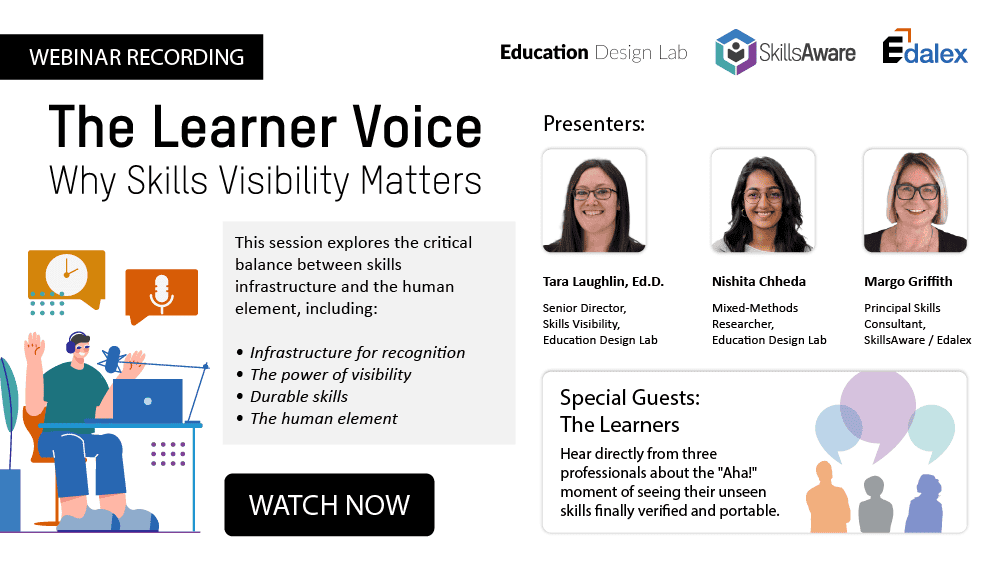
  • WEBINAR RECORDING – From Validation to Visibility: Building a Connected Skills Ecosystem with XCredit

    WEBINAR RECORDING – From Validation to Visibility: Building a Connected Skills Ecosystem with XCredit

    Tuesday, 5 August 2025

    3:00 pm PDT / 6:00 pm EDT
    (Wednesday, 6 August – 8:00 AM AEST)

    Duration: 60 Minutes

    Where: Online via ZOOM


    Watch on-demand the webinar co-hosted by Edalex, Education Design Lab and Unicon Inc. where the panelists explore how XCredit created an interoperable ecosystem that validates skills and connects learners to careers.

    (more…)

  • WEBINAR RECORDING: Unlock Job Growth – Community Colleges as Catalysts for Manufacturing Workforce Development

    WEBINAR RECORDING: Unlock Job Growth – Community Colleges as Catalysts for Manufacturing Workforce Development


    WATCH THE RECORDING

    • 05:05 – AEDC Transforming a Parish Through Strategic Economic Development
    • 12:32 – RPCC Preparing a Skilled Workforce for a New Energy Economy
    • 29:56 – Skills Visibility, AI, and the Future of Recognition: How Edalex Bridges the Gap
    • 43:48 – Q&A

    ABOUT THE SESSION

    Learn how The Ascension Economic Development Corporation (AEDC), who play a vital role in implementing economic development programs for Ascension Parish, Louisiana, worked with industry and Community College leaders to introduce a new industry to the Parish, creating abundant high-paying job opportunities for their community. The session will provide a blueprint for collaborations between community leaders that leads to economic growth.

    Discover how River Parishes Community College is spearheading a proactive approach to workforce development by establishing a dedicated training center to meet the specific demands of a significant regional manufacturing project. This session will offer valuable insights into their model for aligning educational programs with the precise skill requirements of industry partners like Hyundai.

    Gain practical knowledge on how to effectively assess existing community skills and identify critical skills gaps that directly address employer needs. We will also discuss the principles of the skills-based hiring model, demonstrating its tangible impact on workforce pipelines.

    Educational Technology Innovation: Explore the potential of platforms such as SkillsAware and Credentialate to enhance your institution’s ability to understand community skills and provide recognized credentials that align with industry standards.

    Don’t miss this opportunity to learn how strategic partnerships between economic development groups, Community Colleges, and industry are fostering job creation and economic growth through targeted skills development. Register today!

    *Note: By registering for this webinar, you agree to your details being shared with the panel participants.

    Panelists:

    • Kate MacArthur, President/CEO, The Ascension Economic Development Corporation (AEDC): Learn how the AEDC attracts new enterprises and works to maintain and improve the business climate in one of the fastest-growing Parishes in the USA.
    • Quintin D. Taylor – Chancellor, River Parishes Community College: Gain firsthand insights from the leader driving this impactful workforce development initiative.
    • Dan McFadyen – Managing Director, Edalex: Learn how human-centred, AI-powered skills recognition and credentialing solutions are supporting the recognition and validation of manufacturing skills.
    • Tara Rodoni – Edalex US Representative

    [hubspot portal=”2842683″ id=”e053c1f2-add7-4c0c-b990-64f27c290568″ version=”v4″ type=”form”]
     
    About the Panelists:

    Quintin D. Taylor
    Chancellor, River Parishes Community College

    Quintin D. Taylor has served as Chancellor of River Parishes Community College (RPCC) since January 2023, focusing on accountability, customer service, and strengthening partnerships with local industries and schools. With a background in public affairs, communications, and workforce development, he previously led strategic initiatives at the Louisiana Community and Technical College System (LCTCS). A Miami native, Quintin holds degrees in Mass Communications and Public Administration and is pursuing his doctorate. Quintin has re-engaged with local industry and public-school districts to rebuild trust and develop robust partnerships.

    Quintin D. Taylor, Chancellor, River Parishes Community College

    LinkedIn Profile

    Kate MacArthur
    President/CEO, The Ascension Economic Development Corporation (AEDC)

    Kate MacArthur has served as President/CEO of The Ascension Economic Development Corporation (AEDC) in the state of Louisiana since 2017, and is responsible for implementing economic development programs to the benefit of the citizens of Ascension Parish, Louisiana.
    Kate has served as the Executive Director for the Zachary Chamber of Commerce for four years. Prior to that, she was the Director of Marketing & Existing Industry for Myrtle Beach Regional Economic Development Corporation. MacArthur also served as the Director of Business Intelligence for the Baton Rouge Area Chamber for 5 years targeting the recruitment, retention and expansion of business and industry for the nine-parish capital region of Louisiana.

    Kate received a Bachelor of Arts in East Asian Studies with a specialty in International Affairs from Gettysburg College in Gettysburg, PA and a Master’s of Science in Economic Development from The University of Southern Mississippi in Hattiesburg, Mississippi. She is a certified Economic Development Finance Professional from the National Development Council.

    Kate MacArthur - President of AECD

    LinkedIn Profile

    Dan McFadyen
    Managing Director, Edalex

    For the past 20+ years, Dan has focused on enabling innovation in education powered by educational technology and long-term partnerships with educational institutions. This passion fuelled varied roles from a start-up developing the CODiE award-winning EQUELLA software to global educational powerhouses Blackboard and Pearson.

    Since 2016 Dan has served as the Co-Founder and Managing Director of Edalex, tackling skills- and employability-related challenges by supporting the definition, development and recognition of skills through education. On a personal level, as a dual American-Australian citizen, he struggles daily with the conflict between raising his two children on peanut butter and jelly sandwiches, or vegemite.

    Edalex Managing Director - Dan McFadyen

    LinkedIn Profile

    Tara Rodoni
    US Representative, Edalex

    Tara Rodoni is a pioneer in international online education, strategic marketing, and recruitment. She is deeply committed to workforce development and skills-based education. As the founder of Sage Education Marketing, she leads a consultancy specializing in global education and workforce development and advises international companies on expansion into the U.S. market.

    A passionate advocate for emerging markets, Tara has played a key role in fostering education access and innovation worldwide. She has advised organizations at the highest levels, including serving as an advisor to Nelson Mandela, where she helped connect technology companies to support technology initiatives.

    Beyond her work in education, Tara is a committed advocate for child and animal welfare. She actively supports Ukrainian orphan and animal rescue efforts and works on initiatives that provide second chances for women, empowering them through education and career opportunities.

    Tara is also a sought-after global speaker, having delivered talks and led discussions at institutions such as Trinity College Dublin, Dublin City University, UNESCO, and EPIC. Her expertise spans education technology, international student recruitment, and the strategic development of global learning ecosystems.

    Tara Rodoni

    LinkedIn Profile