
Key takeaways
- The power of open standards – open skills and open credentials leverage common frameworks and interoperable technologies to create a more transparent and connected learning and employment ecosystem.
- Breaking down silos for opportunity – by moving away from proprietary systems, open approaches facilitate the seamless exchange and recognition of skills and credentials across different platforms and sectors, unlocking new opportunities for learners and employers.
- Empowering learners with portable recognition – open credentials empower learners by providing them with verifiable and portable records of their skills and achievements that they can easily share and leverage throughout their lifelong learning and career journeys.
The purpose of education in any form can really be boiled down to one thing: opportunities. That includes opportunities for personal improvement, career advancement, increased income levels, and increased levels of personal satisfaction.
The days of working for a single company at a job you might or might not like for a lifetime and then retiring is over. Companies, positions, and the skills needed for those positions change much too rapidly, and the next generation wants a job they are passionate about and can be proud of.
All of those things mean a shift in thinking: the skills a learner brings to any career matter, and those skills may be transferable to another position, company, or even another career entirely. Skills-based education, hiring, and even the creation of job listings are the future. What does that opportunity look like?
Skills are the New Normal
There is a new trend. Workers Skilled Through Alternative Routes, or STARs, is a program that is helping workers “tear through the paper ceiling.” But this is not just about learners and prospective employees. It’s also about companies finding the right candidates to fill positions regardless of the type or age of their education.
In fact, studies show that employers favour proven skills over degrees in many cases. However, the change is still a slow one, as HR departments, personnel, and even some hiring software still rate a degree higher than skills-based data. But with the United States Federal programs favouring skills and other company programs working on internal change, the hope of skills is becoming a reality
Work still needs to be done, though. Many skills-based certificate programs lack the necessary funding for those learners who cannot afford them. While companies are working to provide some of these programs internally, often private programs can be expensive, and at least in the US, are not covered by Federal grant programs or even government-backed student loans.
While micro-credentials are experiencing increased popularity, they are often misunderstood by individuals still, who don’t understand how they relate to job searches and even what to do with them once they have them. Learners also often need help in comparing credentials and determining the actual career currency each one offers. Employers can also struggle with evaluating the duration, intensive, and assessment associated with micro-credentials.
These problems are certainly not the only ones we face in the new realities of education, and there is still more research to be done and areas we need to explore, some we likely are still unaware of.
Regardless, the reality is that skills, whether earned through a degree program or alternative certification programs and other forms of education, are becoming the new currency when it comes to employment outcomes and as measurements of success. But what are these skills, and how do learners not only obtain them but prove they have done so?
In-Demand Skills are Durable, Transferable, and Human
The good news is this: skills can be proven, through digital credentials and in many cases are the most durable part of a learner’s education. What do we mean by that?
Durable skills are ones that constantly evolve. Let’s look at the example of durable skills in sports. “Skills where the environment is constantly changing means modifications are made to the skill each time it is performed. These types of skills are usually externally paced (performer reacts to the situation), as they require judging and interpreting information as the skill is executed,” says Guy Wnuk, PE, in one of his lessons on skills classification.
This is the kind of skill that changes based on external factors the individual must process, and those factors change constantly. These skills are high in complexity and pace: the environment is constantly evolving.
Think of the level of complexity the recent rise of Generative AI-powered tools has caused in a number of industries. Entire careers have been transformed through a single technology and its application. We’ve seen auto manufacturing change with the increase in electric vehicle production, an entirely different process than that of producing internal combustion automobiles.
When you add in the rise of automation in factories, the industry itself has changed from one consisting largely of domain specific skills and manual labour to one involving a variety of both durable and domain-specific skills.
Open Skills to Fast Track Open Credentials
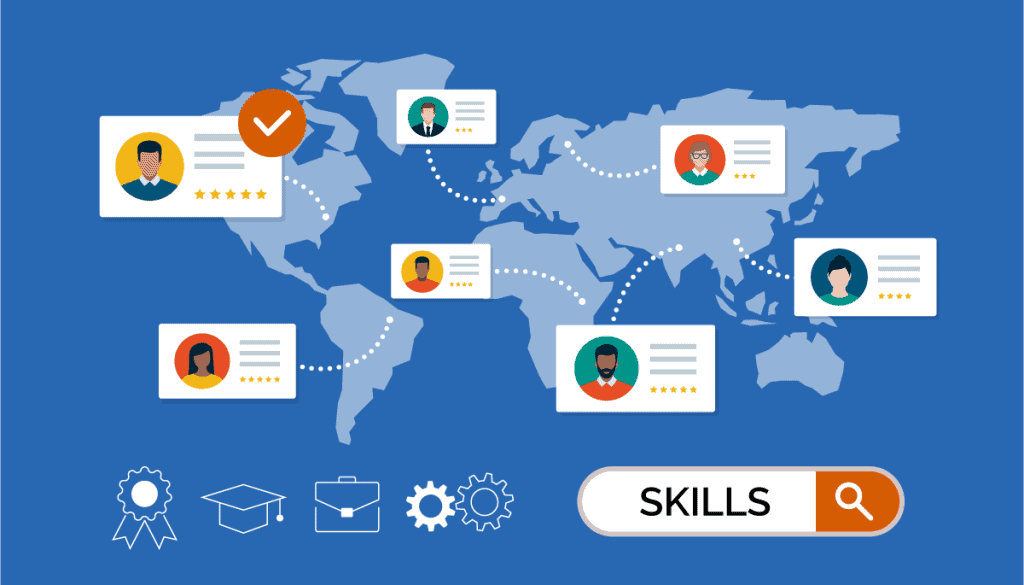
Open skills are developed by, and freely accessible to, a community, universally and for free – think open source software as a comparative example. Libraries of open, accessible and machine-readable skills can be contributed to and referenced by educators, employers and others.
Use of open skills frameworks not only enable quicker adoption through the use of already developed standardised skills resources, such as RSDs, they decentralise and facilitate the creation of a shared skills language that connects the world of learning with the world of work.
The Open Skills Network (OSN), who are “a coalition of employers, education providers, policy makers, military, non-profits, and other stakeholders dedicated to advancing skills-based education and hiring” and open platforms, such as openRSD, a freely accessible library of rich skill descriptors (RSD) are examples of open skills in practice.
Companies can and should plan for the shift to a skills-based economy as described above using open skills. Organisations can, for example, develop a Skills Cloud using digital credentials as verified proof. This Skills Cloud, as described here by David Leaser, must include cognitive skills like writing and understanding the personality traits of your employees and where and how they will excel.
This involves developing a framework that includes a map of the 21st-century skills you need for each position in your company, from thinking skills to leadership skills and other specialised skills related to your organisation. These skills need to show up in your job descriptions, your training materials and in your interviewing and hiring process. Fortunately, using platforms like openRSD, companies can quickly and easily set up their own Skills Cloud.
Adding employee skill assessments then allows a company to see who is a good fit for other roles and how quickly they can be transitioned. But this Skills Cloud and other methods to transition to a Skills Based Organization (SBO) can be easily supported by digital credentials.
Enabling Skills-Based Opportunities Through Technology
Open credentials allow companies to focus on skills clusters rather than just skills keywords. They also allow the focus to shift to proficiencies and the ability to validate skills through different means than traditional certificates and degrees.
Here are some specific recommendations, taken in large part from this study:
For Credential Issuers
Where issuers, such as colleges and universities, choose to make the transition to digital credentials, they need to prioritise the use of widely accepted standards – such as the Open Badges Specification 3.0 and Comprehensive Learner Record Standard which co-exist quite nicely. Technologies and strategies that are interoperable should be adopted whenever possible.
In choosing credential solutions, issuers should prioritise credentialing technology that addresses the following requirements:
- Is based upon a set of open standards, managed transparently by an independent body or organisation
- Allows learners or jobseekers to control and share their records
- Provides tools to automatically verify authenticity for long after the credential has been issued
- Can capture rich structured metadata, preferably as linked open data
- Is accepted by validators for employment use cases
By adhering to these principles, issuers can ensure that their efforts would help increase recognition and acceptance not only of their own credentials but of digital credentials generally. In fact, educators can learn a lot from the corporate world and their current use of skills data.
For Employers
As to employers, they can and should do a couple of things as well:
- Develop their own employer-based credentialing programs, even on a pilot program level. That way, employees can showcase skills acquired through job experience and throughout their employment, and understand the skills valued and in demand at that employer
- Invest in open skills and competency frameworks that bridge positions, industries, and even careers. These open frameworks hold the greatest promise for the future
Governments and other Stakeholders
The investment in credentials and credential programs is not only the responsibility of educators and employers. Skills-based learning and hiring are good for every aspect of the economy and benefit governments and their citizens as a whole and should be supported by policymakers.
Open Opportunities
Next-generation learning is powered by technology. At the heart of it all rests digital credentials and the necessary infrastructure surrounding them, and that is where we focus here at Edalex. If the aim is to think big, start small and move fast – we’re ideally placed to partner with you on your journey. We take your education institution from the concept stage to a working digital credential model that meets all of the requirements of today and can be modified as needed to meet your future needs.
This allows you to create stackable credentials that can be combined to lead to larger certificates and degrees, all with varying areas of focus and all consisting of visible, transportable, and personal evidence records that will become the currency of the skills economy.
Digital credentials also enable employers to not only recognise but document learning that happens in the workplace, making it an essential component of learner evidence records (LERs). All of these digital credentials can be funnelled into skills wallets, much like physical wallets. They house personal evidence records that are verifiable, transportable, and secure.
The skills economy is here. Education, employment and learners are evolving to embrace this emerging technology. We are closer than ever to widespread adoption. The good news is that you can be a part of this revolution, and we at Edalex are here to help.
Contact us to set up a demo or ask any questions you might have. We have the tools you need, and we’ll work with you through every step of the transformation process. Let’s change the way we look at skills, education, and employment together.
FAQs
What are “open skills” and “open credentials,” and how do they differ from traditional approaches?
Open skills refer to using common frameworks and definitions to describe skills in a way that is understandable and usable across different systems and sectors. Open credentials are digital credentials built on open standards, making them verifiable, portable, and interoperable, unlike many traditional qualifications that are often tied to a specific institution or platform.
Why is interoperability important in the context of skills and credentials?
Interoperability allows different systems and platforms used by educational institutions, employers, and individuals to “talk” to each other. This seamless exchange of data about skills and credentials reduces friction, eliminates silos, and enables a more efficient and transparent recognition of learning and abilities.
How do open credentials empower learners and benefit their career prospects?
Open credentials provide learners with digital records of their skills and achievements that they own and can easily share with potential employers, educational institutions, and professional networks. This portability and verifiability can enhance their credibility, open up new career pathways, and provide lifelong value as their skills evolve.
What role do standards and specifications play in enabling open skills and open credentials?
Standards and specifications provide the technical and semantic frameworks that ensure interoperability and common understanding. They define how skills are described, how credentials are issued and verified, and how different systems can exchange this information effectively. Examples include open badges standards and frameworks for rich skill descriptors.
What are the potential benefits of a widespread adoption of open skills and open credentials for the broader learning and employment ecosystem?
Widespread adoption can lead to a more transparent and efficient labor market, where employers can more easily identify individuals with the specific skills they need, and learners can be better matched with opportunities. It can also foster innovation in educational technology and create a more equitable and accessible learning landscape.