Key Takeaways
- Building bridges is better than breaking down silos: Instead of trying to destroy data silos, which can be an unrealistic approach, a better strategy is to build bridges between them to enable sharing and collaboration. This allows silos to change and possibly disappear organically over time.
- Reasons for silos: Silos often arise from different software systems, data that has not been digitized, a lack of data sharing among departments, and the use of legacy software.
- Problems caused by silos: Silos lead to several issues, including duplication of efforts and content, inconsistent messaging across departments, wasted human and physical resources, a poor user experience, and missed opportunities for innovation and efficiency.
- Solutions for building bridges: Several strategies for building bridges include: renovating organizational structures to promote collaboration, implementing a central content repository, developing a common taxonomy for consistent language, and prioritizing a culture of collaboration.
- openEQUELLA as a solution: openEQUELLA can address these issues. The platform is a content-centric digital repository that integrates with learning management systems (LMS), helps liberate content from silos, and enables institutions to manage, control, and share digital assets efficiently.
DOWNLOAD WHITEPAPER
Download openEQUELLA Whitepaper: Why Data Silos Need Bridges – Closing the Content Access Gap
Use the menu below to navigate to the section you would like to read:
When we talk about data and content silos, sometimes we hear people talk about breaking them down. In fact, there are speakers who take the stage at nearly every data and education conference who talk about dynamiting silos, breaking them down, and making data accessible to all: a true system of records shared institution-wide.
The truth is, this is an unrealistic approach. Silos, while often created by legacy thinking and programs, can serve a necessary purpose. Rather than plotting their destruction, a better approach is to work on building bridges. As those bridges are built, silos will organically change and some of them may even disappear.
But before we dive into why silos need bridges, we need to define why they exist in the first place, what causes them, and the issues produced by silos, and then we can look at how those bridges can be created.
Where Data and Content Silos Come From
First of all, data silos come from a variety of sources in the education world, and understanding their source and purpose will help us understand how to build bridges between them.
Let’s look at a few real-world examples.
Different Software Systems
At the University of Idaho, the Idaho Geological Survey (IGS) department is housed. Much of their data relates to geographical features and mining events. As a result, much of the data is housed in an ESRI-based database that helps to manage geographic information systems (GIS). This is the best way to manage the data they have available and to meaningfully analyze it.
“For geologic data, both past and present, often the best way to represent it is through mapping,” Earl Bennet, the former state geologist stated. “It can now be visualized in three dimensions, and this gives it a true value for the students and geologists who might access the data as well.” Therefore in this department, a silo has been created that is both efficient and necessary.
But the same University also houses the Special Collections for the state as part of their library. Much of the data in the special collections have not been digitized at all. If it has, the data is held in Past Perfect, a data storage program often used by museums and libraries to catalog artifacts. While much of the material talks about the mining history of the state, there is no bridge to the GIS data of the Geolog Survey.
“The biography of a mine owner is not all geologically related,” Ellen Cahill told us when we asked her about the connection. “And sometimes we don’t even know what the IGS has that might relate. With enough time [and funding] we could certainly make the connection and would love to. But it’s simply not a priority.”
This is just a case of data that could be related not really being “bridged” because the departments use different technology and there is no shared center of information.
Data Has Not Been Digitized
Another common issue is that some data has never been digitized.
“Unless someone has a reason to look at the data, and is willing to either pay to have it digitized or digitize it themselves, much of what we have is sitting in old-fashioned file folders in steel fire cabinets,” Cahill said. “There are thousands of pieces of historically interesting and perhaps significant data that is rarely, if ever, seen.”
But the same is often true of course data. Different departments use different software to manage course data, and while in theory it should all be entered into a central program, it just doesn’t always happen.
Data is Simply Not Shared
“The other issue,” James Ritter, a curriculum developer at the University of Idaho said, “is that no one is looking. The English department doesn’t look at the biology department curriculum to see where there might be overlap and vice versa. We’re trying to improve the process, and things are getting better, but we still find duplication.”
Besides different focus, sometimes there is also the issue of ownership. Departments want to control how their content is used, and by sharing it with another department, that control and authority are compromised even though the initial creator still feels a responsibility to ensure its integrity.
Legacy Software
In some cases, it’s not a matter of just different software. It’s that each department has its own legacy software, and implementing new systems takes both time and money. While it doesn’t always work for collaboration, it works, so why fix what isn’t broken?
Essentially those who administer departments must be convinced that the improvements of a new system and shared data and the benefits that brings would be worth the significant investment at a time when education budgets are tight at best.
It’s important to understand that all of these are potential ways that silos have come about. While users can often see the value of bridges, actually building them seems like a monumental task, and often those who could change things have no idea where to start.
But why start in the first place? What’s wrong with silos anyway?
The Issues with Data and Content Silos
At this point, it’s fair to ask the question. What is the problem silos cause, and why is building bridges so important? There are several answers, and no one is universal or more important than the other, but all of them can have an equal impact on an organization. Let’s look at a few of them.
Duplication
This is one of the simplest issues to spot, but one of the toughest ones to solve. For example, an English department may offer a Verbal Communication 101 class, essentially beginning speech. Perhaps they have tailored it toward English majors in some way they feel is unique.
The communication department at the same university may offer the same course and they may even share the same name. But that department may feel their course has a superior element.
From a learner’s perspective, they could take either course with the same outcome. They likely don’t care what department the class is in, only that it is offered in a time slot that works for their schedule.
While this is a simple example, there are countless others where the same information is taught in a similar way in different departments, but all of those courses could be reduced to one in a central, related department with no loss for the learner.
The same is true in companies or at an administration level. Duplication often occurs simply because there is no bridge between departments.

Inconsistent Messaging
The overall university policies might say one thing and the geology department guidelines say something else entirely. For the learner, they don’t know which to follow and what the “true” answer to a question is. This is in large part because departments do not communicate, and their information is siloed.
This can happen when a student changes majors and discovers courses that “counted” in the pursuit of one degree no longer count, and they have to take even more courses to graduate. Not only does this produce frustration in the learner, but it also wastes resources.
Wasted Resources
Professors have limited time and energy. Asking them to teach one more course might not seem like a horrible idea, but it can add hours to an already full workload. And if another department teaches a similar course? That human resource could be teaching something else, or actually have more time to interact with learners.
But silos are not just about wasting time and human resources. It’s also about physical resources. Servers cost money to run and maintain, and even cloud services have limits and payment tiers. Silos tend to take up more space, especially when content is duplicated or nearly so, and when you look across the board at a university or other institution of higher learning even a small waste multiplied by several departments adds up.
If that isn’t bad enough, it’s also not good for the user. Any of them.
Poor User Experience
When we mention a poor user experience, we often refer to the learner. But when it comes to data and content, they are not the only users. In fact, content creators, content distributors, and the end user can all be classified into this category.
And for these users, silos can be a huge source of frustration. The information they need can be out of reach or require additional steps to obtain. Creators may have to add data to multiple platforms or in multiple locations to make it available to everyone who needs access.
The same is true of those who share the data. Think of the extra steps that must be taken to pull data from several different silos to provide a complete picture.
In fact, some organizations become so siloed that as key personnel move on, no one knows how and where to pull various pieces of information. While this may sound extreme, many organizations find themselves in similar situations.
Missed Opportunities
The end result? Missed opportunities for innovation and building more efficient systems. Silos break down communication, and this makes it difficult to capitalize on the value offered by shared data. A bridge builds trust and confidence, while silos shut it down.
This openness with data has been proven in companies and governments to foster creativity and ignite ingenuity (2016, M. Yankova).
So if silos are needed to organize and structure data, but by their nature cause problems, what then is the solution?
Building Bridges Using openEQUELLA
As we stated at the start, the key is not to break silos down, a nearly impossible task, but to build bridges. What do those bridges look like, and how do we create them?
The solutions can sound simple at first glance, but can actually be complex to execute. Let’s look at a few of them, through the use of the open source digital repository, openEQUELLA.
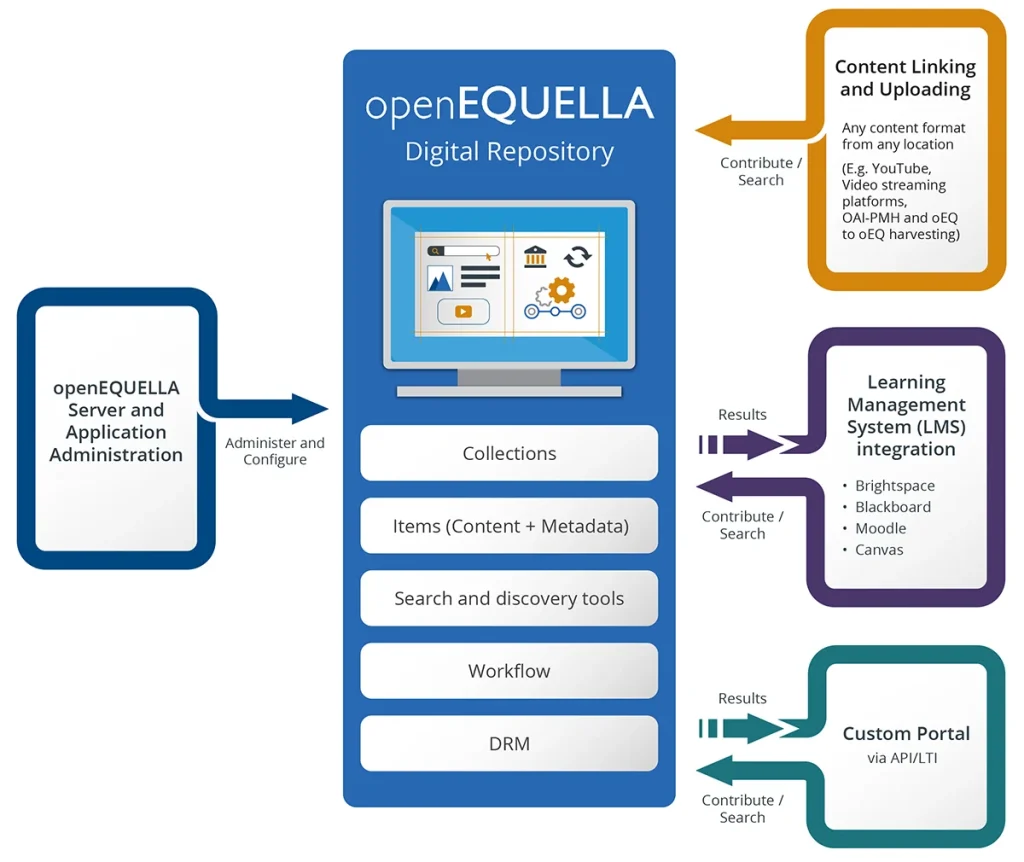
openEQUELLA gives you control, access and flexibility over your digital content on an open source platform. Your staff won’t have to reinvent the wheel every time and you can free your digital content from within siloed learning management system (LMS) courses, making them accessible, able to be improved upon, repurposed for use in multiple places and shared easily across your institution.
Designed specifically to fit centrally in the education ecosystem, openEQUELLA sits in the center of your edTech stack and acts as a ‘single source of truth’ to house your teaching and learning, research, media, library and skills content.
openEQUELLA has been deployed for copyright resource collections, research materials, managing and exposing materials through websites and portals, content authoring, workflow, institutional policy and organizational resources.
Renovate Organizational Structure
One common issue is the structure of the organization itself, an issue that creates silos and fortifies them (2021, J. Borden). The key is to restructure in a way that promotes communication, collaboration, and sharing. This is no small task, and while forming an organization with a more open data-sharing culture is simpler, changing a legacy mindset is harder and takes much longer.
Of course, it does not matter if the organization agrees that this is a great idea if there are not other tools in place.
“I can tell you with great confidence that an LMS is not a ’connection’ tool. An LMS has a much more limited scope,” said Jeff Borden, when he was Chief Academic Officer, Campus App, at Campus (currently Vice Provost of the Learning Experience at National University). “We assembled a team of academics and IT staff and other ed tech specialists (learning designers, etc.) and librarians . . . you get the idea. But their remit was all about institutional goals, user experience concepts, and operational efficiencies,” he continued.
A learning management system (LMS) is a critical component of most educational technology ecosystems, with the majority of leading LMSes providing some level of basic content management. However, at its core, an LMS is course-centric, in which access to course content is limited to those either teaching or taking a specific course.
Conversely, openEQUELLA is content-centric, with a focus on the lifecycle of the content stored within the platform: from creation, editing, new versioning, archiving etc. With a focus on the content, an institution is able to ensure content can be easily discovered, managed and then delivered to learners via the LMS, leveraging the strengths of both platforms.
According to Lee Webster, Director Learning Technology Innovation and Services at TAFE Queensland: “We were relatively early adopters of EQUELLA (as it was known then) as part of a combined effort to implement a learning management system (LMS) and learning content management system across 12 out of the 13 state-based TAFE institutions. “ openEQUELLA forced us to stop and really think through how we wanted to set things up that would make sense with where the organization was heading,” Webster continued.
“We were relatively early adopters of EQUELLA (as it was known then) as part of a combined effort to implement a learning management system (LMS) and learning content management system across 12 out of the 13 state-based TAFE institutions. openEQUELLA forced us to stop and really think through how we wanted toset things up that would make sense with where the organization was heading,”
Lee Webster, Director Learning Technology Innovation and Services at TAFE Queensland
Implement a Central Content Repository
0This action, too, is one that is both simpler and more complex than it at first seems. Regardless of the format or program that data is created or stored in, it is possible with a platform like openEQUELLA to create a central content repository where all relevant data is linked in some way and can be analyzed.
But the fact that it is possible does not mean it is easy. There are several steps and each involves resolving complex issues that take both time and money. No matter how great the central repository software is, data must still be migrated into it, and for that to work, there are still other necessary steps.
Anton Proppe, Manager, Library Discovery at Swinburne University of Technology and his team members, Nyss Parkes and Robert Rochester comprise the Swinburne Commons management team. They’ve worked together for many years and from the initial adoption of openEQUELLA in 2013. “With such a variety of digital repository needs, the full configuration options that openEQUELLA provided really made it stand out from the pack,” Parkes shared. “That, and the number of search and display options,” Rochester clarified. “The full-text searchability was a great asset for archival material and research queries,” he went on to say.
Macquarie University teaching staff were finding that as they created and copied courses in Moodle, there was a lot of duplicated content in their systems – which used up a significant amount of space. Not only that, learning and teaching resources that might ideally be used across multiple courses, could not easily be shared with fellow teachers or between courses within the LMS resulting in lots of duplicated time and effort. openEQUELLA provided the ideal solution as a centrally housed digital repository. “Once they start using it, they find out how easy it is to use – and after that, there’s no stopping them,” Hassan said with a chuckle.
Develop or Implement a Common Taxonomy
One of the biggest obstacles to building data and content bridges is vocabulary. We must develop a common language and taxonomy so that for everyone, terms mean the same thing. In the area of education, this can be a unique challenge, especially when it comes to defining skills and illustrating those learned in a specific course.
Developing and agreeing on a set of e-Standards was central to the quality control strategy for Webster’s team. They started by setting up master product collections and a dedicated product development unit. “This immediately increased content sharing and reduced duplicated effort,” she explained.
Even from the beginning, the Swinburne Commons team put thoughtful consideration towards the eventual size of the collections they would amass over time. “Due to the public focus, metadata quality control was a key consideration for us, right off the bat,” Proppe stated emphatically.
Having a high level of data integrity has ultimately given the Swinburne Commons team a level of flexibility and control over their digital resources at an astounding level. “We have a single source of truth for our resources,” Rochester related to us, “which means that we can write our own schema to harvest or push-out resources to our own or other libraries. Once this is set up, openEQUELLA can apply the schema structure to all of the existing resources, and bring resources together from multiple collections so that the resources you want to show in a new series, just appear. In fact, openEQUELLA makes it really easy to do this, and means that we can display collections in precisely the way we want them to appear, without having to conform to a locked-in template,” he rounded out, thoughtfully.
Prioritize Collaboration
Collaboration needs to be the focus for bridges to be effectively built. Collaboration and usability are often the missing ingredients. Functionality matters as well, but without the first two, it doesn’t have the impact it could.
“An LMS is not generally considered a place for sharing. It’s one reason we called our instance of openEQUELLA “iShare”, to encourage resource sharing among staff,” said Mahbub Hassan, Senior Technology Specialist at Macquarie University.
In most cases, this means a culture shift, one that moves from “What is good for my department?” to “What is good for the organization overall?” It also focuses on what is good for the users, from creators to disseminators to the data recipients.
“We pursued a publishing, rather than self-publishing approach,” Proppe said, “because at the end point, the value we could add was helping staff distribute a quality final product. Fortunately, over time, contributors have come to know our standards and strive to meet them. We’ve also built in systems so that if they’re not sure or prefer for us to look it over first, they can send to us to action, meaning that now, despite some of our collections numbering in the thousands of resources, our data management is clear and consistent,” he elaborated further.
“…with openEQUELLA, anyone accessing the content has a full picture of its lifecycle, including any licensing relating to the course, and assessment quality and compliance information. And as an administrator, we have visibility of review dates, requests and version information. We can run validation reports to check that the content meets our internal guidelines. At a glance, you’re ticking off regulation, quality and compliance issues,” Webster commented.
Next Steps
When we look around the digital world we see every day, it’s easy for us to say that silos create issues, bridges are better, and collaboration is essential to organizational success. But what’s easy to say is not always easy to implement.
In the long run, though, the implementation process is worth it. Organizations see less duplication, more consistent messaging, fewer wasted efforts, and a better user experience overall.
Adopting openEQUELLA in 2007 and subsequently implementing an internal content management and quality control team has resulted in TAFE Queensland being able to offer a high-quality, consistent student experience. For teachers, creating new courses and enhancing course content as new resources and assessments are developed has been significantly more efficient. “openEquella has enabled TAFE Queensland to manage its vast catalog of learning and assessment resources, aiding continuous improvement and ensuring that our teachers have ready access to high quality and compliant learning and assessment resources,” said Webster.
And it’s all possible when collaboration becomes a priority and a culture shift is achieved. With patience and the right partners, you can make it happen in your organization. It’s time to build bridges, not silos. And it all starts with you – and openEQUELLA.
With openEQUELLA, you can:
- Catalog, search and find easier – organize your content in the way that best aligns with your institution’s internal processes and tag for easy discoverability. Use the powerful internal search engine to search, sort and filter to find your content fast
- Liberate your content – content is usually locked away in silos across the institution. Help your staff create, develop and improve their work quickly and easily using resources already created by their colleagues
- Manage and control – from the administrator console, control and manage metadata, permissions, and overall access control
- Capture and maximize use – make sure your digital assets don’t walk out the door when staff do! Capture, edit and update content with reusability in mind
- Maintain quality – streamline data handling and maintain quality standards. Update one Master asset and push the update out to all other instances where the asset is used
- Reduce costs – consolidate down from multiple platforms to a single or only a few platforms, costing you less in licensing fees, vendor management and maintenance and reduce the duplicated time and effort of your staff at every level
- Join or participate in the content sharing economy – institutions who’ve established commercial education content arrangements can identify, control and manage access to specific content items or broad content collections in open or closed environments
Platform features that really impress:
- Plays well with consumer and provider systems and platforms – developed with interoperability in mind, openEQUELLA integrates seamlessly with all major LMSs and offers rich API and LTI connections for other systems or 3rd-party platforms
- Supports collections that are open, closed or both – share as much or as little as you want, with the ability to create private and public collections – increasingly desired in the emerging content sharing economy
- Quality assurance workflows and version control – for highly regulated industries, like aviation, medical, engineering and law, meet rigorous education content standards with verification, approval and version control workflows
- Highly customisable to meet your precise needs and objectives – openEQUELLA can be customized to within an inch of its life! This is no jest, with features like custom taxonomies, custom workflows and its flexible custom-reporting engine
DOWNLOAD WHITEPAPER
Download openEQUELLA Whitepaper: Why Data Silos Need Bridges – Closing the Content Access Gap
FAQs
- What are some of the main reasons data and content silos are created?
Silos are often the result of different software systems, a lack of data digitization, departments not sharing information, and the use of outdated legacy software. - Why is building “bridges” a better approach than “breaking down” silos?
Breaking down silos is often unrealistic because they can serve a necessary purpose. Building bridges allows for a more organic and realistic change, enabling communication and sharing between departments without necessarily destroying the underlying organizational structures. - What problems do silos cause for an organization?
Silos can lead to duplication of work, inconsistent information, wasted resources, a poor experience for users (including creators and end-users), and missed opportunities for creativity and ingenuity. - How can an organization start building bridges between its silos?
The document suggests several steps, including restructuring the organization to promote collaboration, implementing a central content repository, creating a common vocabulary and taxonomy, and prioritizing a culture of sharing. - How does openEQUELLA help with this process?
openEQUELLA is presented as a digital repository that can act as a central “single source of truth” for an institution’s content. It aims to help manage and organize content, make it easily searchable and reusable, and integrate with existing systems to improve quality and reduce costs.
Authors
Alistair Oliver
Director & Co-Founder
For the past 20+ years, Al has engaged with senior leaders across all education sectors to assist them in defining suitable educational technology solutions to meet their varying needs. With a career spanning executive leadership roles, marketing, business development, and account management, Al led the team that established the EQUELLA brand and was heavily involved in its entry into the global education market, through to its acquisition by Pearson. Al has fostered strong relationships with customers across the globe. Al relies on the support of his wife and two children to ease the pain of being a die-hard St. Kilda Saints supporter.

Kristine Chompff
Marketing Manager
Kristine has worked in competitive, dynamic and high-growth environments for over 20 years, primarily in professional development and higher education. She has an in-depth understanding of education technology, having spent much of her time working with leading international edtech organisations in product development and in bringing cutting edge platforms to market.
She is an avid lifelong learner and believes in the power of technology to improve learners’ lives.
Troy Lambert
Freelance Writer
Troy is a freelance writer, author, and editor who is passionate about the future of education, and equipping tomorrow’s learners with the skills they need to succeed in today’s workforce and the ability to clearly communicate their academic and personal achievements to enhance employability. A lifelong learner, Troy lives, works, and plays in Boise, Idaho with his wife and a pack of talented dogs, at least one of which may have contributed to this article