
Lens on Learners – The Many Types of Modern Learners
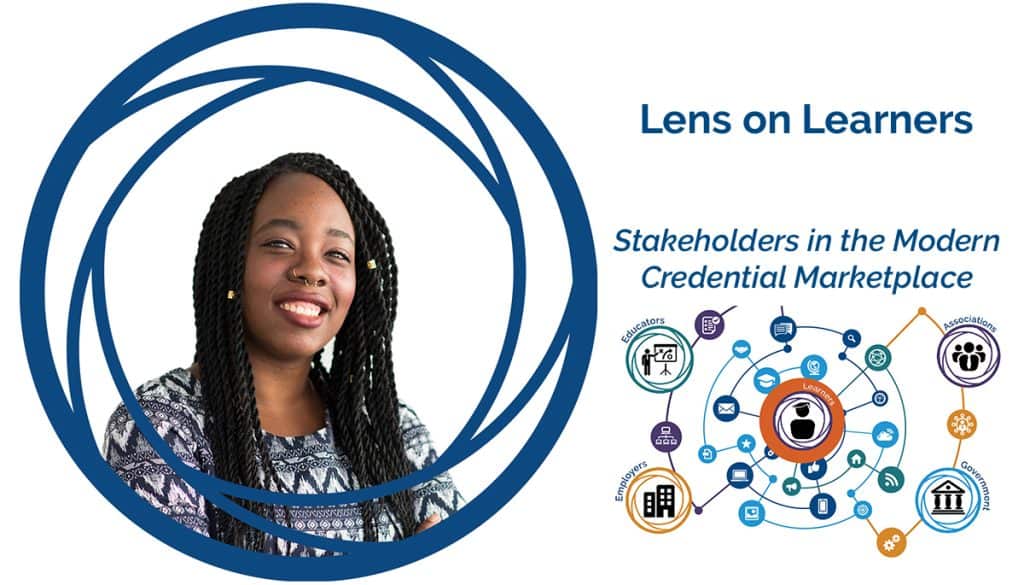
What does the word ‘learner’ mean to you today – and compared to 5 years ago? What about in 5 years from now? As the world of work has changed, so learners too – significantly in some respects. In our new blog series, Lens on Learners, we’ll take a deep dive into what learners look […]
Authentic Assessment of Critical Skills and Career Readiness
In this conversation style interview, Margo Griffith and Doris Zahner, PhD from the Council for Aid to Education discuss authentic assessment of essential skills for career success, such as critical thinking, problem-solving and written communication. Zahner discusses how authentic assessment accurately measures critical skills, the evidence of authentic assessments that is provided to educators and learners and how different institutions use attainment of critical skills data.
Weaving the Future of Micro-Credentials – Addressing the Wicked Problems

Throughout this series, the same questions have come up again and again. We aren’t going to pretend to have all the answers. And in outlining these ‘wicked problems’, we’re not saying that there is no work currently being done to address them: there is. In this final piece, we seek to highlight not only how […]
Skills-Based Learning – When, Where, How and Why

Skills-based learning is not the learning formula for tomorrow. It’s the learning formula for today. most skills-based learning is taking place in more informal, lifelong learning environments that come either after, alongside, or in some cases in place of formal education. In this information-rich Credentialate Guide, we explore how education providers are addressing the increasing demand for skills development and verification.
Integrating Industry, Educators and Skills-Based Curricula

We all know there’s a skills gap. It’s real, it’s a problem, and it’s time that we move beyond talking about what it is, how large it is and why it matters to a more important topic – what do we do about it?
Aligning Employability and 21st-Century Skills

We must define employability, and understand that being employable does not equal being employed. The two terms are often used interchangeably and are confused with one another. But they are different, and that difference is related to the very purpose of teaching 21st-century skills in the first place.
Frameworks – Proving Capability, Skill and Competency

While it would be great to have a federal or even global framework, because of the needs of different organizations, any framework must be adapted to meet their needs. Let’s look at the purpose of frameworks, flexibility, funding, and what it all means when we put it together.
Thoughts, Insights and Recommendations for Rethinking Employability
In this conversation style interview, Margo Griffith and Emeritus Professor Beverley Oliver dicuss Oliver’s research, thoughts and insights on rethinking employability after the release of her Whitepaper recently. She also provides further context around her recommendation that education providers focus on 3 factors that signal employability to their learners.
Skills-Based Hiring – Agreeing on the Language of Employability

Definition of the terms ‘skills’ and ‘competencies’ in conjunction with ‘capability’ are vital to developing any framework against which a person can be assessed and matched to a particular position or career path.
Reflections on Employability Beyond 2020

Edalex recently had the opportunity to support research that Emeritus Professor Beverley Oliver conducted on the topic of employability, culminating in the release of the whitepaper Rethinking Employability Beyond 2020: Ten Recommendations for Universities.