
Author: Edalex
Summary
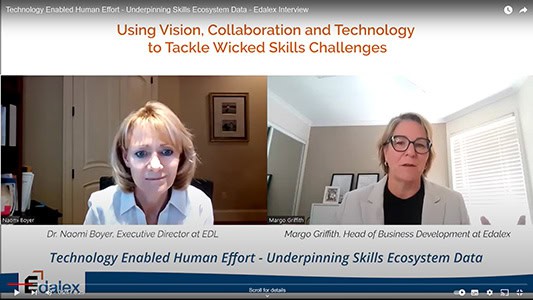
The discussion between Margo Griffith of Edalex and Naomi Boyer of Education Design Lab revolves around the integration of technology into the skills ecosystem and its crucial role in enabling individuals to showcase their competencies in the talent marketplace. Boyer emphasises the importance of visibility and digital enablement in career development, arguing that the traditional reliance on degrees and social networks often restricts opportunities for many individuals. Instead, a connected skills ecosystem, underpinned by technological tools, offers a more equitable and effective approach.
Boyer outlines a six-step process to enhance an individual’s digital discoverability and create a robust skills ecosystem:
- Identification of Competencies: Employers and academic programs must identify and associate job roles and educational programs with relevant competencies, rather than just learning outcomes. This step requires human effort, not just technological solutions, to ensure that competencies are accurately linked to skills, knowledge, and abilities.
- Compilation into Digital Frameworks: These competencies need to be compiled into open digital competency frameworks. This is facilitated by adopting standardised technological tools that allow information to be shared across various organisations and platforms.
- Integration with Learning Experiences: The competencies and skills identified must be integrated into learning experiences, whether through formal education or workplace training. Technology systems such as learning management systems and HR platforms play a key role in linking these skills to real-world applications.
- Documentation of Achievements: Organisations need to document these achievements using digital micro-credentials or Comprehensive Learner Records. These records serve as formal documentation that validates what individuals have learned and achieved.
- Empowering Individuals: The focus then shifts to the learner-earner, who must collect and catalogue their skills across different experiences. Technological tools like digital wallets help individuals manage and showcase their competencies, giving them agency over their career development.
- The Resume of the Future: The final step involves creating a dynamic, technology-enabled resume that allows individuals to effectively signal their competencies to employers. This ‘resume of the future’ is key to bridging the gap between individual skills and employer needs, ultimately facilitating smoother hiring processes and internal mobility within organisations.
Boyer concludes by highlighting the importance of global partnerships in advancing this skills-based approach, suggesting that collaboration across borders will be essential in elevating skills recognition worldwide.
Note: You can watch the full interview here – Using Vision, Collaboration and Technology to Tackle Wicked Skills Challenges